Category Archives: Q. Akabir

The reason for not benefiting in tariq!

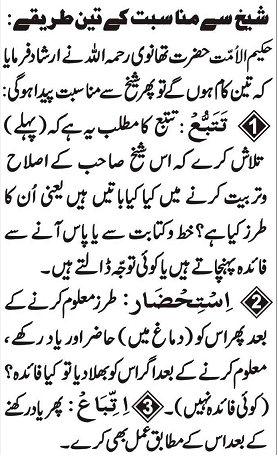
Shahykh Shah Wasiullah (Allah have mercy on him) said,

‘Are you aware of the reason that why some of the people who come here (for islah &ta’aluq maAllah) do not benefit?

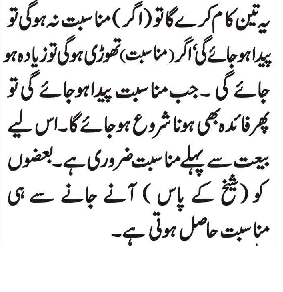
The reason is that this path (tariq) essentially requires propriety (adab) and reverence (aqidat).

People consider this path to be  similar to the conditions in secular schools where a tutor teaches and the pupil learn irrespective of having any reverence  for him.  The student learns even if he does not show any respect to the teacher.

They consider that the teaching in Tasawwuf is also like this and there is no need of reverence and propriety towards the Shaykh.

Shaykh’s instructions are considered to be beneficial and are memorized, however, there is no reverence for the Shaykh in their heart. It is for this reason that they do not benefit.

It is as though Tasawwuf is now considered to  be another branch of  science and arts. In reality, it is a practical and  experiential entity.

Hakim al-Umma Mawlana Ashraf Ali Thanawi (Allah have mercy on him) told us multiple times that if someone questioned Shaykh Haji Imdadullah mohajir Makki (Allah have mercy on him) regarding an issue (mas’ala) of Tasawwuf. He used to admonish the inquirer and tell him that this is not a school (maderasa) whenever (a need is felt and) I find it appropriate  I will explain it.’

Taharet e qalb, Nifaq ka bayan, page 83

Not proper for a Believer to disgrace himself

The honorable Companion Huzaifah (Allah be pleased with him) narrates that the Prophet of Allah (blessings and peace of Allah be upon him) said:

“It is not proper for a Believer to disgrace himself.”

It was asked: “O  Prophet of Allah !  What is meant by this?”

The Prophet of Allah (blessings and peace of Allah be upon him) said: “To undertake something which you cannot bear.” (Tirmizi)

Hakim al-Umma Mawlana Asharf Ali Thanawi (Allah have mercy on him) explains,

To assume a task beyond one’s capability is not proper for a believer . The consequence will be failure, disgrace, worry, and shame. Frustration will then overtake one.

This saying of the Prophet (hadith) covers all such acts and tasks which are beyond one’s power. In all such cases of difficulties adopt patience (sabr) and supplicate to Allah  for aid.

Hayat al-Muslimeen, chapter 10, Rights of oneself

Phantom of ijazah

Someone had written to Hakim al-Umma Mawlana Ashraf ‘Ali Thanawi (Allah have mercy on him),
You have given ijaazat to a particular person but we do not see him to be fit for this position. Must we rely on your ijaazat or on what we see of him?

Hakim al-Umma replied,
‘You should act according to what you have witnessed and you are not bound by my ijaazat. There are various reasons for me giving ijaazat.’

Malfoozat of Faqeeh al-Ummat, page 458

Sufi’s piety

Someone informed Hadhrat Mianji Nur Mohammad (Allah have mercy on him) of a man who had an exceptionally beautiful voice. The informer suggested to listen to his performance of  a naa’t (poetry in praise of Prophet, Allah bless him and give him peace) .

Hadhrat Mianji said:

“Sometimes people ask me to be the Imam (leader in prayers). There is difference of opinion on the validity of singing even without the accompaniment of musical instruments. Therefore,  it is more cautious not to  listen to it. Hence, I shall not listen.”

After narrating this episode Hakim al-umma Mawlana Thanawi (Allah have mercy on him) commented:

“This indicates the degree of his respect and regard for the post of Imam. He abstained from even an ikhtilaaf (an act which some say is permissible and others say is impermissible). This was a real Sufi who cared so much for the Shariah.”

Tarikh Mashaikh e Chisht, page 94

How to deal with a difficulty?


Arif-billah Dr. Abdul-Hayy ‘Arifi (Allah have mercy on him) said:

When faced with a difficulty which seems to be either unavoidable or irresolvable, our Hadhrat (Hakim al-Umma) used to advice us not to think and ruminate about it. Start making dua in your heart regarding it. And repeatedly recite اياك نعبد و اياك نستعين.

By doing so, inshaAllah, the anxiety will vanish, peacefulness will be achieved and the difficult task will be settled with ease.”

Ma’moolat-e-yoomia 25-6

Husn-e-dhan


Mawlānā Shabbīr Ahmad `Uthmānī رحمه الله تعالي mentions:

Those scholars who have used harsh words against Imām Abū Hanīfah رحمه الله تعالي , we should only think good regarding them as a believer is jealous (ghayyūr) and sincere in his intentions. When he is informed of something which seems to be contradicting the sunnah and destroying dīn (even though in reality it is not so) then his jealousy for dīn overtakes him causing him to get angry for the pleasure of Allāh Ta`ālā. Thus, resulting in him using harsh words in defence of the dīn.

An example of this is Imām Muslim رحمه الله تعالي using strong words against Imām Bukhārī رحمه الله تعالي in his muqaddimah. Most commentators have preferred the view of Imām Bukhārī رحمه الله تعالي but they did not criticise Imām Muslim رحمه الله تعالي for using harsh words. (Fathul Mulhim 1/73)

Extracted from Ask Imam fatwa #18609

A lesson and reminder for us.

Our scholars and mashaykh do the same regarding those who reviled their akabir. Even those who went to the extent of making corrupt allegation of kufr against them.

Example of husun e khuluq!

A solidier  slapped Shaykh Ibrahim ibne Adham (Allah have mercy on him) mistakenly.  On recognizing his error he returned to apologize.

Shaykh Ibne Adham (Allah have mercy on him) told him that when you slapped me I supplicated to Allah to grant you paradise (jannah).  The shocked soldier requested an explanation for this extraordinary behaviour.

Shaykh explained that I was certain that I will be rewarded (by Allah) for this slapping and it made me uncomfortable that you cause me reward and good and in return you get sin and punishment (in here-after). Therefore I supplicated for you.

Ahzab tahzib un nafus,  Munajat e maqbool, ((zamimajat, Saeedi)) page 305