Category Archives: D. Acts of Worship

Various acts of devotion to show our servitude

Repentance at predawn

Mawlana Fazalur-Rehman Ganjmuradabadi (Allah have mercy on him) said,

‘If nothing else is possible at tahajjud (pre-twilight) time one should at least do some repentance (isteghfar).

In Holy Quran Allah says

وبالأسحار هم يستغفرون

not                        ھم یصلون

The complier adds, relative to tahajjud salat, Shaykh stressed more on getting up at tahujjud and repenting. Recalling one’s sins, acknowledging these transgressions and crying.’

Irshad e Rehmani wa fazal e yazdani, page 25

Deen is not Difficult at all!

Sayyidi wa sanadi Mawlana Muhammad Taqi Usmani (Allah preserve him and allow us to benefit from him abundantly. Ameen!) said:

“Once I was visiting Shaykh Baba Najam Ahsan, khalifa majaz-e-sohbat of Hakim al-Umma (Allah have mercy on them). He was an extra-ordinary personality. Gifted with khashaf-o-karamat (unveiling of secrets and super natural acts). A young man came for an errand. He was like other youths of his age, having no religious desires & inclination. As he completed his work and was about to leave, Baba sahib addressed him and said;

“Son! people think that following deen in very difficult in this day and age.

They are wrong. It is not difficult at all.

Only thing you have to do is to repent for your mistakes daily at night time. That is it!”

I was amazed!
But these ahl-ul Allah are in a quest to bring people to Allah any how and by whatever means. It is impossible that if one develops this habit of repentance daily that he does not develop a relationship with Allah.”

Waaz 3th July 05, Darul Uloom, Karachi

Silence

____________________________

The Prophet (Allah bless him and give him peace) said:

 من كان يؤمن بالله واليوم الآخر فليقل خيرا أو ليصمت

“Whoever believes in Allah and the Last Day let him speak good or remain silent.”

[Bukhari and Muslim]

The Sufiya suggest that this applies to all types of talking. That is, of the tongue (speech) and that of heart & mind (active thinking)!

____________________________

Counting the blessings!

Hadhrat Mawlana Mufti Mohammad Taqi Usmani (may Allah preserve him) said,

“Once my Shaykh Hadhrat Dr. Abdul Hayy ‘Arifi (may Allah have mercy on him) was invited to a dinner. Few of his disciples, including me were accompanying him. After the sumptuous meal Hadhrat addressed us regarding the excessive thankfulness due on each and every blessing.

Hadhrat enumerated that in this single episode how many blessings were incorporated. First blessing was the delicious food itself. Second, the respectful manner in which the host served it to us. Third, our feeling of hunger which made it possible for us to consume it. Fourth, our good general health that allowed us to eat indiscriminately. If we had an aliment we would have to restrict ourselves to specific foods only. Fifth, our being free from overwhelming and disturbing thoughts. If a close family member had been sick it would have been impossible to enjoy the delicious meal. Sixth, the company of friends and pious individuals we had. Rude and irreligious fellows would had made the whole event a miserable experience. So on and so forth the list of blessings will continue. We are aware that it is essential to give thanks for each and every of these blessings. True and real thanks will gush out from the depths of the heart with realization of these things.

Hadhrat Mufti sahib added, the ability to appreciate the blessings in such manner is due to a very close and intimate relationship with Allah (taluq ma’Allah), that is the goal of Tasawwuf.

These are gems to take from Shaykh’s company (suhba). “

Friday 27th July 2007, Masjid Darul Uloom, Karachi. After ‘asr majlis

Salafi advice

The great spiritual master Dhu’n Nun al-Masri (Allah have mercy on him) said:

“The early Muslims (salaf) would counsel each other with three counsels:

First: Whoever rectifies their relationship with Allah, Allah rectifies their relationships with people.

Second: Whoever rectifies their inward, Allah rectifies their outward.

Third: Whoever rectifies their Hereafter, Allah rectifies their worldly life.”

[Sharh al-Hikam al-Ghawthiyya, 111]

Source: Seeker’s Guidance

The use of nur of good deeds!

Arif-billah Dr. Abdul Hayy ‘Arifi (Allah have mercy on him) said,

It is not sufficient enough a goal to become a zakir (one who does excessive remembrance of Allah) and shagil (one who does spiritual exercises) only.

You acquired the nur by praying pre-dawn prayers (tahajjud) and doing remembrance of Allah. This is very good.

However, dear brother, is there a potential use of this nur?

The (nur of) remembrance of Allah makes the darkness go away, the obscurities fade, the rights and obligations become clear in front of you, the filthy and pure things become evident clearly in their appropriate places.

Now, why do you pick up the filth?

If by mistake you did this then remember Allah, throw it away and wash your hands.

(As a example:) Being a human you got angry. Now why do keep a grudge and intention of revenge? Throw away this filth and repent. The use of remembrance of Allah is to be shown here.

Sawanih wa ta’limat e Hazrat ‘Arifi, page 530

Objective of attending the majalis

Shaykh Mansur Ali Khan (Allah preserve him) said,

‘Every week we gather here to listen to religious discussion. It is imperative that we have a clear objective regarding these gatherings.

These are not lectures of formal religious education. These are training sessions (tarbiyeti) for the spiritual aspirants (salikeen).

Their objectives are, to

1. Create and nurture love of Allah and His beloved Prophet (blessings and peace of Allah be upon him) in our hearts.

2. Develop the habit of turning (ruju’) to Allah in all circumstances via supplication (dua).

3. Emulating the Sunna method of doing things in every aspect of life.

4. Becoming cognizant of here-after and accountability for one’s deeds.

It is essential to have these goals in mind. It makes the journey easier by keeping you on the track and retuning to it if you slip.’

Sunday majlis, Jeddah, 3rd July 2010

Ashrafiya precisian: The daily wird

Points to bear in mind for the daily routine (wird) of a novice seeker.

Go slow and easy initially.
Do not exhaust yourself by fixing a routine that is beyond your limits. (Inform the Shaykh upfront of your limitations).
Make lot of prayers (dua) for ease, guidance and acceptance from Allah in this regards.

Also, it must be remembered that all these things are supererogatory (nafil). They provide assistance in fulfilling the essential actions (wajibat) to gain Allah’s pleasure. The most important of which is to abstain from all that is impermissible (sins).

Also, your duties as a sonْ/daughter, brother/sister, spouse, parent, employee at work, or student in college have priority over all these nafil activities. This means that when there is a clash between these two kind of activities precedence in given to the wajib. If there is no clash then it is highly recommended to do them diligently.

Min ifadat e murshidi

Tip to avoid a burnout!

Hakim al-Umma Mawlana Ashraf ‘Ali Thanawi (Allah have mercy on him) said,

‘My respected teacher Mawlana Yaqub Nanotawi (Allah have mercy on him) used to advice the seekers that they should end their routine activities (wird, tilawat, tasbihat, readings, etc.)  before they loose complete interest  in them. Leaving a desire to still do more. If they do not do this they will have a burnout (experience of long-term exhaustion and diminished interest) eventually.

Allah save us all form this.

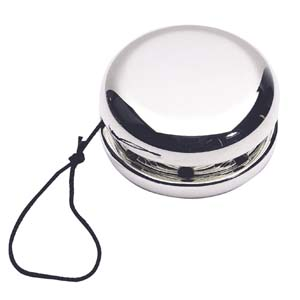
To make it easier to understand he gave the example of yo-yo (Urdu:chakai/chukdor). The tip for successful play is to pull the string before it unwinds completely. If it were to unwind totally the yo-yo spool will never return and just dangle there aimlessly.

Similar is the tip for a salik (and the instructing murshid) to keep the flame of interest and desire burning.

Undertaking too much, too quickly with drastic lifestyle changes over a short period of time  is usually spiritually unhealthy.

The natural spiritual growth is slow, continuous and imperceptible process. Just like the physical development. Years and decades are required to reach and manifest the signs of spiritual puberty and maturity.

A perfect murshid (Shaykh-e-kamil) is needed for this reason.

(Paraphrased. Malfuz reported in Majalis e Hakim al-Ummat ra, and repeated many times by sayyidi wa sanadi wa murshidi Mufti Mohammad Taqi Usmani (Allah preserve him) in his discourses.)
Bidah

lmam Ghazali has reported from our master Hasan Basri (Allah have mercy on them) a narrative that Satan said:

“I presented sinful deeds in an attactive form to the Muslims, but they nullified my efforts through repentance (istighfar). Then I presented before them vices in the garb of virtues, thus leaving no initiative for repentance.”

Instances of such vices are self-made innovations (bidah) in religious practices.

Vitues of Zikr, page 133

Not proper for a Believer to disgrace himself

The honorable Companion Huzaifah (Allah be pleased with him) narrates that the Prophet of Allah (blessings and peace of Allah be upon him) said:

“It is not proper for a Believer to disgrace himself.”

It was asked: “O  Prophet of Allah !  What is meant by this?”

The Prophet of Allah (blessings and peace of Allah be upon him) said: “To undertake something which you cannot bear.” (Tirmizi)

Hakim al-Umma Mawlana Asharf Ali Thanawi (Allah have mercy on him) explains,

To assume a task beyond one’s capability is not proper for a believer . The consequence will be failure, disgrace, worry, and shame. Frustration will then overtake one.

This saying of the Prophet (hadith) covers all such acts and tasks which are beyond one’s power. In all such cases of difficulties adopt patience (sabr) and supplicate to Allah  for aid.

Hayat al-Muslimeen, chapter 10, Rights of oneself

Sufi’s piety

Someone informed Hadhrat Mianji Nur Mohammad (Allah have mercy on him) of a man who had an exceptionally beautiful voice. The informer suggested to listen to his performance of  a naa’t (poetry in praise of Prophet, Allah bless him and give him peace) .

Hadhrat Mianji said:

“Sometimes people ask me to be the Imam (leader in prayers). There is difference of opinion on the validity of singing even without the accompaniment of musical instruments. Therefore,  it is more cautious not to  listen to it. Hence, I shall not listen.”

After narrating this episode Hakim al-umma Mawlana Thanawi (Allah have mercy on him) commented:

“This indicates the degree of his respect and regard for the post of Imam. He abstained from even an ikhtilaaf (an act which some say is permissible and others say is impermissible). This was a real Sufi who cared so much for the Shariah.”

Tarikh Mashaikh e Chisht, page 94