
Category Archives: J. Rights
Shaykh

Some people are lazy in taking a Shaikh.
Whereas, some do not get a new Shaikh after the demise of the first one.
These are our shortcomings.
We should strife to make sure that not a single day or night passes by on us without we being under the guidance of a Shaikh (graduate spiritual mentor).
Hayyat e Sarwar db, page 86
A beneficial talk!

New book

A Collection of Speeches by sayyidi wa sanadi Mufti Muhammad Taqi Usmani (Allah preserve him) taken from Discourses on Islamic Way Of Life.
Paying financial dues: A priority!

Sayyidi wa sanadi Mawlana Mohammad Taqi Usmani (Allah preserve him) instructs those approaching him for reformation (islah),
‘If there are pending financial obligations prompt arrangement must be made to pay these dues.
If the payment is not possible immediately then one should inform the owner and request for a grace period.
Then one should really strive meticulously to repay. This must be considered the topmost priority.’
Dastur al-amal baraay talibeen e islah, page 5-6
مواعظ اشرفیہ

Desired good company

_____________
Hakim al-Ummah Mawlana Ashraf `Ali Thanawi (may Allah have mercy on him) writes:
“Allah Most High has put this quality in humans that they are quickly and substantially affected by the thoughts and conditions of others.
[This occurs even] without any specific effort, and happens whether it is good or bad company.
Good company is an element of immense benefit; in the same way, bad company is an element of tremendous harm.
Good company is of such a person who, based on the need, has a grasp on the issues of Deen, and one has good faith in him. He abstains from Shirk, innovation, and worldly affairs. His actions are good, and he is firm and constant in his Salah, fasting, and other necessary acts of worship. His dealings are good and his transactions are clean. He is careful about issues of Halal and Haram. His outward behavior is also excellent. He has a humble disposition and he does not harm anyone without reason. He does not consider the poor and needy to be inferior. His inner qualities are also pleasing. He keeps the love and fear of Allah Most High in his heart. He does not keep much greed for the world in his heart. [When in] conflict with the Deen, he does not care for wealth, comfort, or disgrace. He keeps the Hereafter in front of him, and does not keep this world dear to him. He is patient and thankful in every circumstance.
If someone is found with these qualities, his company is an elixir.
If someone cannot fully recognize these qualities, for him (assistance in) recognition is to seek the pious people of his time, those who are considered by most Muslims to be pious. They should speak well (of him). And after remaining in his company several times, the heart should shy away from blameworthy traits and turn towards praiseworthy morals. Consider such a person to be pious and adopt his company.”
Hayat al-Muslimeen, p. 27 (Multan: Idara Ta’lifaat Ashrafiya)
By Brother I. Khan
Husn-e-dhan

Mawlānā Shabbīr Ahmad `Uthmānī رحمه الله تعالي mentions:
Those scholars who have used harsh words against Imām Abū Hanīfah رحمه الله تعالي , we should only think good regarding them as a believer is jealous (ghayyūr) and sincere in his intentions. When he is informed of something which seems to be contradicting the sunnah and destroying dīn (even though in reality it is not so) then his jealousy for dīn overtakes him causing him to get angry for the pleasure of Allāh Ta`ālā. Thus, resulting in him using harsh words in defence of the dīn.
An example of this is Imām Muslim رحمه الله تعالي using strong words against Imām Bukhārī رحمه الله تعالي in his muqaddimah. Most commentators have preferred the view of Imām Bukhārī رحمه الله تعالي but they did not criticise Imām Muslim رحمه الله تعالي for using harsh words. (Fathul Mulhim 1/73)
Extracted from Ask Imam fatwa #18609
A lesson and reminder for us.
Our scholars and mashaykh do the same regarding those who reviled their akabir. Even those who went to the extent of making corrupt allegation of kufr against them.
Important message

Example of husun e khuluq!

A solidier slapped Shaykh Ibrahim ibne Adham (Allah have mercy on him) mistakenly. On recognizing his error he returned to apologize.
Shaykh Ibne Adham (Allah have mercy on him) told him that when you slapped me I supplicated to Allah to grant you paradise (jannah). The shocked soldier requested an explanation for this extraordinary behaviour.
Shaykh explained that I was certain that I will be rewarded (by Allah) for this slapping and it made me uncomfortable that you cause me reward and good and in return you get sin and punishment (in here-after). Therefore I supplicated for you.
Ahzab tahzib un nafus, Munajat e maqbool, ((zamimajat, Saeedi)) page 305
Jihad al-Akbar

There is a consensus among all the well established Sufi masters that the foundation stone of Tasawwuf and spiritual path (sulook) is to cleanse the nafs (lower self) of the blame worthy moral traits (razail).
This is achieved by the aspirant using his determination (himmat) to act against the desires of his nafs.
This acting against the nafs is called the spiritual struggle (mujahidah), endeavor (riyadah) and jihad al-akbar.
Neither excessive remembrance (dhikr), offering supererogatory salah, recitation of litanies and Holy Quran nor even the observance of the essentials (faraiz) disciplines the nafs. This is because the role of these things in removal of blame worthy characteristics is that of secondary assistance and not primary treatment. The individual will receive their reward and merits respectively. However, it is against the norms set by Allah that the nafs be disciplined without meticulous spiritual struggle (mujahidah).
This is the reason we observe that most of the religious individuals are inflicted with blame worthy moral characteristics in spite of their extra worship.
Ahzab tahzib un nafus, Munajat e maqbool, (zamimajat, Saeedi) page 301
What is husun al-khuluq?

_____________
In summary excellent conduct (husun al-khuluq) is that,
1. In reply to harm and incitement by others one makes supplication (dua) for them or acts in an exemplary good manner.
2. Not to pay attention to the misconduct of others in the first place (i.e Ignore it).
3. Not being selfish.
4. Being very cautious not to become angry.
5. Be extremely careful not to be arrogant.
_________________________________
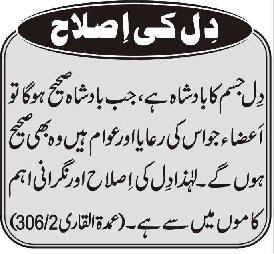
Ahzab tahzib un nafus, Munajat e maqbool, ((zamimajat, Saeedi)) page 306
Vienna airport
Sincerity

____________________________________
‘Considering one’s self to be sincere is in it self a sign of lack of sincerity.’
___________________
_____________
Ahzab tahzib un nafus, Munajat e maqbool, ((zamimajat, Saeedi)) page 302
____________
ECCMID 2010, Vienna, Austria
Tajweedi Quran


A very useful resource for individuals’ trying to improve their Quran recitation.
Real Message of Seerah

Sayyid wa sanadi Mawlana Mohammad Taqi Usmani (Allah preserve him) wrote:
“What really is important with regard to the Holy Prophet, (Allah’s blessings and peace be upon him) is,
first to follow his teachings,
and second to make his pious Seerah available to every Muslim,
to preserve it in the hearts of the Muslims from the very childhood,
to educate the family members to run their lives according to it and
to hold it as the most glorious example of the human conduct the universe has ever witnessed.
To do all this with utmost love and reverence, not manifested by some formal activities only, but also through actual behavior of following the Sunnah.
This cannot be done by merely holding processions and illuminating the walls.
This requires constant and consistent efforts and a meaningful program of education and training.”
Islamic Months: Rabiul Awal