Category Archives: Q. Akabir

Sunna prior to Fajr salah

fajr1

fajr2In the discussion about offering the two rakah Sunna salah prior to Fajr once iqamah has been called, sayyidi wa sanadi Mufti Mohammad Taqi Usmani (Allah preserve him) said,

‘The authentic saying of Imam Abu Hanifa (Allah have mercy on him) and dhahir al rewaya is also that with two criteria being fulfilled it is permissible to offer this salah. Firstly, it is expected that one complete rakah (of the fardh salat al fajr) will be attainable. Secondly, that they must be offered out side the mosque.

Imam Mohammad (Allah have mercy on him) said that even if not one complete rakah only the last sitting (qaida al akhira) is expected to be attainable than also it is permissible to offer these Sunna .

Imam Mohammad (Allah have mercy on him) added further to the first criteria but not to the second one (that is to offer it outside the mosque).

Imam Tahawi (Allah have mercy on him) added to the second criteria. He said offering them outside mosque it is permissible, however, inside the mosque is also permissible provided it is far away from the rows of the congregational salah and in an isolated spot.

From all this discussion it is clear that the prevalent practice of offering this salah immediately behind the congregation or few rows away is not permissible according to any of the madhahib.

The predominant (viewpoint) is to follow the original way (madhab) of Imam Abu Hanifa (Allah have mercy on him). The Hanafi researches have given preference to this.  However, Allama Shami (Ibne Abideen) keeping in consideration the feeble Muslims has given fatwa according to Imam Tahawi (Allah have mercy on them).

Whereas, our Hanafi researchers, that include respected (Shaikh Anwar) Shah (Kashmiri, Allah have mercy on him) do not agree. They stick to the original madhab of Imam Abu Hanifa (Allah have mercy on him). That is, one rakat is expected to be attainable and it is offered outside the mosque.

Another issue to be acknowledged is that the permissibility Imam Tahawi (Allah have mercy on him) gave for offering this salah in mosque was during an era when loud speaker were nonexistent and there was no clash between the recitation of the Imam and one offering his salah in an isolated corner. Nowadays when the recitation in (congregational) salah is being relayed on the loud speaker I have doubts about the permissibility of offering this (Sunna) salah in mosque. This is because there is clash of recitation in this situations. It is, therefore, best to offer it outside the mosque.’

Im’anul Bari, volume 3, page 416-7

Passing on rewards of good deeds to pious

20131007-081809.jpg

An individual wrote about his daily routine of reciting some verses of Holy Quran and passing on the reward (esal e thawab) to pious predecessors.

Hakim al Umma Mawlana Ashraf Ali Thanawi (Allah have mercy on him) appreciated the practice but made it clear that this must not be with the expectation that in return there will be spiritual benefit from their souls. This would be against sincerity. The passing on of rewards must be solely for Allah’s pleasure in appreciation of the services they provided in spreading the Deen.

Paraphrased from Tarbiyet us Salik,

Moreover, some people who do esal e thawab routinely are afraid that if they stop it, even for a genuine reason (poor health or lack of finances, etc.) there will wrath of these pious predecessors and some disaster will strike them. This is shirk. May Allah protect us all from this. Amin!

Vallejo, CA

Etiquette of Haramain Sharifain

20130925-120127.jpg

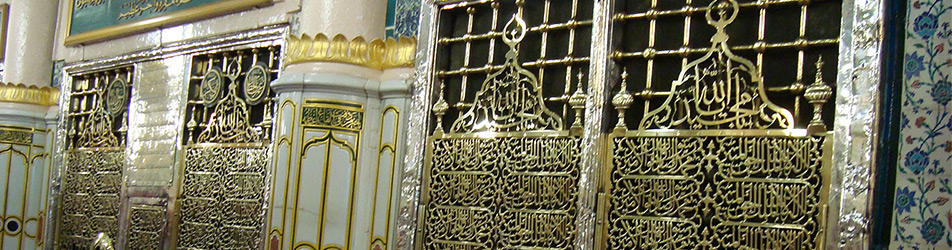
Every Muslim desires to visit the blessed and radiant cities of Makkah and Medinah (Haramain sharifain: the noble sanctuaries). At least once in his lifetime.

For many this opportunity comes with the performance of Hajj. Others get this chance when they visit for Umrah. Sometimes repeatedly.  Few individuals are blessed to get jobs in these cities and earn their living there.

All of these moments spend in the noble sanctuaries are extremely precious. A virtuous deed done in these precincts can earn a reward of 50,000 to 100,000 times performed elsewhere.  An unimaginable bonus!

Each and very second has to be utilized effectively to reap maximum benefit. A challenging task indeed. Especially, for individuals like us who are not organized and motivated. Laziness, apathy and negligence become the major barriers.  Moreover, committing sinful acts in these sanctuaries are  reciprocally or extra-reprehensible and blameworthy.

It is for these reasons some pious scholars have advised against taking permanent or prolonged residence in these noble  sanctuaries. They include our Imam Abu Hanifa (Allah have mercy on him).

Shaikh Haji Imdadullah mohajir Makki (Allah have mercy on him) advised an Indian  nawwab planning to migrate to Hijaz,

‘Staying in Hindustan and having a desire to live in noble sanctuaries is better than living here and being occupied in your stately affairs in Hindustan.’

Shaikhul Hadith Mawlana Zakariya mohajir Madani (Allah have mercy on him) use to tell those expressing their desire to migrate to Medinah e munawwarah,

‘Do not make such a decision of migration by observing my example. I have come here (towards the end of my life) to die (and be buried in Baqi).’

In short, the etiquette of the noble sanctuaries are significant and have to be taken very seriously.

The interview: Medinah e munawwarah 19th Ziqada 1434


Condemnation of attack on Christians in Pakistan

 012

Shaikhul Hadith Mawlana Zakariya mohajir Madani  (Allah have mercy on him) said,

‘In fact the matter concerning dhimmis  (ذمی) in these affairs (i.e. rights of Non-Muslims living in an Islamic state) is far more serious than that of Muslims.

The Prophet (blessings and peace of Allah be upon him) said in this regards,

‘He who oppresses any Dhimmi, or defames and degrades him, or demands from him anything more than he can bear or do, I will stand against that person and make demand in favor of that dhimmi on the Day of Judgemnent.’

This is truly a very serious matter and a point worthy of great concern.

At the most critical moment (on the Day of Judgement) ones’s own attorney and defendant (the Prophet, blessings and peace of Allah be upon him) becomes the prosecutor. How tragic this situation can be?

‘My Pakistani friends must be very cautious regarding this as the non-Muslim (living) there are Dhimmis in all respect.’

Prescribed Preliminary Practices, page 5-6

Shaih al Bukhari , Volume 9, Book 83, Number 49: 

Narrated ‘Abdullah bin ‘Amr:

The Prophet said, “Whoever killed a Mu’ahid (a person who is granted           the pledge of protection by the Muslims) shall not smell the fragrance          of Paradise though its fragrance can be smelt at a distance of forty           years (of traveling).”

012

Medinah al munawwarah

For those visiting Medinah e munawwarah

book1It is highly recommended that those individuals who are proceeding to the radiant blessed city of Medinah have this book with them.

Thorough reading with intention to follow each and every Sunna must be done. The reading should be organized in such a manner that whole book is completed in their stay. It will bring much blessings and save them from wasting time in idle talk and involvement in suspicious or sinful activity.

As per sayyidi wa sanadi Mufti Mohammad Taqi Usmani (Allah preserve him) the memorization of the Prophetic prayer wordings in Arabic must be done. These wordings have their own barakah and radiance.

Insha Allah, this will increase the chances of their visitation to be accepted.

wa ma taufiqi illah billah!

Termination of islahi ta’luq

20130820-195248.jpg

Sayyidi wa sanadi Mufti Mohammad Taqi Usmani (Allah preserve him) has made it very clear upfront in ‘Dasturul amal baraay talibeen e islah‘ that if there is a gap of more than six months in communication from the seeker in updating about his/her condition the islahi relationship will be terminated. Usually this is permanent.

However, there are exceptions.
The best approach is to humbly acknowledge one’s mistake, request for a second chance and be willing to accept the reprimand..

Most important thing is not to insist on one’s own demand. Actually it is bigger mistake to do so. Also, there is no role of asking senior murideen or mujazeen to intervene and plead one’s case. It usually backfires.

There is a lesson in this all. It is part of spiritual training tarbiyah.

Rules for the Shaikh

20130817-150213.jpg

Hakim al Umma Mawlana Ashraf Ali Thanawi (Allah have mercy on him) said,

‘Even the Shaikh should not sit idle. He should keep progressing in excellence.
Allah says,

‘and say, “My Lord, improve me in knowledge.” ‘[20:114]

He should not make a claim of excellence. However, there is no problem in mentioning the blessings (of Allah bestowed on him).

Allah says,

‘So, do not claim purity (from faults) for your selves.’ [53:32]

And

‘And about the bounty of your Lord, do talk.’ [93:11]

He should be eager on spreading the tariqa
Allah says,

‘who is very anxious for your welfare, [9:128]

He should be very kind and loving with the disciples.
Allah says,
‘and for the believers he is very kind, very merciful.’ [9:128]

He should forgive their shortcomings and mistakes.
Allah says,
‘Had you been rough and hard-hearted, they would have dispersed from around you. So, pardon them, and seek Forgiveness for them.’ [3:159]

He should not ignore them for the the sake of (wealthy or famous) worldly individuals.
Allah says,
Do not expel those who call out to their Lord morning and evening seeking His pleasure. You are not responsible for anything in their account, and they are not responsible for anything in your account, that you should expel them, and thus become one of the unjust. [6:52]

He should not expect any worldly benefit from the disciples.
Allah says,

‘Keep yourself content with those who call their Lord morning and evening, seeking His pleasure, and let not your eyes overlook them, seeking the splendor of the worldly life. And do not obey the one whose heart We have made heedless of Our remembrance,’ [18:28]
And,
‘ I did not demand any reward from you. My reward is with none except Allah,’ [10:72]

He should remain patient on the afflictions caused by fellow men.
Prophet (Allah bless him and give him peace) said,
‘May Allah have mercy on my brother Musa, who was afflicted more than this (by his Umma) but he remained patient.’

He should maintain serenity and dignity. Otherwise disciple will consider him to be paltry and will not benefit from him (spiritually).
As is said regarding our Prophet (Allah bless him and give him peace) that whoever saw him from far away was intimated and whoever saw him from close by loved him.

He should not give preference to a disciple over others.
Allah says, ‘He (the Prophet) frowned and turned his face,’ [80:1]
However, if a disciple has more yearning of Allah(‘s pleasure) than it is fine to give preference to him.

He should not do anything that will make people have a bad opinion about him. As this will close the path (tareeq) of seeking instructions and benefiting (irshad).
Allah says,
‘the one who calls (people) towards Allah,’ [33:46]

Taleemud Deen, page 129-31

Wali’s limits

20130815-103658.jpg

Hakim al Umma Mawlana Ashraf Ali Thanawi (Allah have mercy on him) said,

‘A friend of Allah (wali) can never reach the status of any of the Prophets.

The acts of worship (that are essential) can never be waived off. On the contrary the elite (friends of Allah) are instructed to do more acts of worship.

However, a majzoob, who has a overwhelming state is excused.

The wali is neither infallible (m’asoom) nor can he reach the status of the Companions (of Prophet, Allah bless him and grant him peace). Allah says in this regards,

‘You are the best ‘Ummah ever raised for mankind.’ [3:110]

And the Prophet (Allah bless him and grant him peace) said,
‘You are the best nation out of the people.’

Moreover, there is consensus (ijma) of the scholars that all of the Companions are just.

Abdullah ibn al Mubarak (Allah have mercy on him) who was from the taba’een, said, ‘the dust in the nose of horse that Sayyidina Muawiyah (Allah be pleased with him) rode is better than Owais al Qarni and Umar al Marwani (Allah have mercy on them.’

Taleemud Deen, page 128

Maintaining respect of awliya

20130814-102333.jpg

Hakim al Umma Mawlana Ashraf Ali Thanawi (Allah have mercy on him) said,

‘Negligence in maintaining etiquette (adab) of friends of Allah (awliya) is forbidden.

Similar, and more worse, is the case of excessive and overenthusiastic attitude in this regards.
This is because, it diminishes the status of Allah and the Prophet.

For example, considering awliya to be ‘Alim ul ghayib‘ (having knowledge of ‘unseen’*). This (assumption) necessitates unbelief (kufr).
Allah says,

Say, “No one in the heavens and the earth has the knowledge of the Unseen except Allah.” [27:65]

Say, “I do not say to you that I have the treasures of Allah, nor do I have the knowledge of the Unseen, nor do I say to you that I am an angel. I only follow what is revealed to me.” ” [6:50]

“………….they encompass nothing of His knowledge, except what He wills.” [2:255]

Or considering them (awliya) to have powers to create or destroy something or give children or provision, etc. or coerce Allah to do so is also unbelief (kufr).

Say, “I have no power to bring a benefit or a harm to myself, except that which Allah wills.” [7:188]

Or to perform an act for them (awliya) from the (established) actions of worship (ibadaat). Like, intending a vow (nazar) in their name, or performing tawaf of their grave, or supplicating to them, or recitation of their name as form of worship. Some of these acts are sinful and innovation, and others are unbelief (kufr) and associating partners with Allah (shirk).

Allah says,

“You alone do we worship, and from You alone do we seek help.” [1:5]

The Prophet (Allah bless him and grant him peace) said,
Tawaf (circumbulation) of the House (of Allah: ka’ba) is (like) salah.”

«الدعاء هو العبادة»
“Supplications (dua) is (form of) worship”.

Allah says,

“Your Lord has said, “Call Me, I will respond to you. Definitely those who show arrogance against worshiping Me shall enter Jahannam (Hell) with disgrace.” [40:60]

“Surely, those whom you invoke beside Allah are slaves (of Allah) like you.” [7:194]

Taleemud Deen, page 127-9

Awliya are not infallible

20130813-103707.jpg

Hakim al Umma Mawlana Ashraf Ali Thanawi (Allah have mercy on him) said,

‘One should not criticize the Shaikh if he infrequently commits something questionable.

One should remind himself of the story of Sayyedina Musa and Khidr (Allah’s peace be upon them).

20130813-104801.jpg

20130813-104847.jpg

Either make an excuse or recall that friends of Allah (awliya) are not infallible. Moreover, with repentance all (sins) are forgiven.

However, this is for the Shaikh who is steadfast on Shariah and is firmly rooted (in piety) and it is an (isolated) act (of disobedience) committed accidentally. If this individual has made the acts of disobedience (fisq o fujoor) his habit, openly and in secret, then he is not a friend of Allah (wali). There is no need to make an excuse for his speech and actions. One should leave him.’

Taleemud Deen, page 126-7

Status of one’s Shaikh

20130812-100030.jpg

Hakim al Umma Mawlana Ashraf Ali Thanawi (Allah have mercy on him) said,

‘It is acclaimed that one should consider his Shaikh superior to all other (Shuyukh).

Apparently there seems to be a contradiction in this and what Allah says,

…………….Above every man of knowledge, there is someone more knowledgeable.[12:76]

(To reconcile these) it must be clear that if one thinks like this due to overwhelming love (sukr e muhabbat) then he is excused.

If one is not in a state of overwhelm-ness than he should think that in living individuals I can not find anyone else who can benefit me more (spiritually) than this individual.
This is what my Shaikh sayyidi wa sanadi al Haaj Mohammad Imdadullah (Allah have mercy on him) said.’

Taleemud Deen, page 126

Making multiple bayiah

20130810-105341.jpg

20130810-105354.jpg

Hakim al Umma Mawlana Ashraf Ali Thanawi (Allah have mercy on him) said,

‘It is an abominable practice and (sign of spiritual) debauchery to make bayiah with multiple Shuyukh without a genuine reason.

This results in loss of the blessings (barakah) of bayiah.

Moreover, it befogs the (spiritual beneficence received from the) heart (qalb) of the Shaykh and ripping of the (spiritual) connection (nisbet) is feared.

Such a person gains the reputation of being a (spiritual) delinquent.

Taleemud Deen, page 125-6

In regards to taking another Shaikh

20130807-120256.jpg

Hakim al Umma Mawlana Ashraf Ali Thanawi (Allah have mercy on him) said,

‘If an individual with correct intention stayed in the service of a Shaikh for considerable duration but did not find any influence (ta’seer) in his company than he should seek his objective at another place. This is because the objective is Allah not the Shaikh.

However, one should not have bad belief about the first Shaikh. It is possible that he is perfect and accomplished but one’s share was not there.

Similarly, if the Shaikh dies before the objective is achieved or it is impossible to meet him then one should seek another Shaikh. The thought of benefiting from his grave being sufficient and no need for another living Shaikh must not be entertained . This is because the benefiting from the grave is not for instruction (and guidance), only a sahib e nisbet can benefit, resulting in progress of his state (Ahwal). Whereas, this individual is still in need of instruction. Moreover, if this was the case (that benefiting from grave of pious was enough) then there would be no need of bayiah (taking another Shaikh). There are millions of graves of perfect Shuyukh and even Prophets (to benefit from in the world).

Taleemud Deen, page 125

Doubts & questions

20130621-225204.jpg

A scholar approached Hakim al Umma Mawlana Ashraf Ali Thanawi (Allah have mercy on him). He stated that he had some questions and doubts about the belief of pre-determination of affairs (taqdeer). He added that he had done extensive research about this topic and read almost all the major texts regarding this issue. However, he still remained unsatisfied.

Hakim al Umma replied that this was not the way to approach the matter of doubts and questions.

A thorough reply may for the time being provide a satisfying answer. However, this is usually for a short duration. The lower self (nafs) comes up with an antithesis or another more powerful question or doubt. Thus, it becomes a vicious cycle. Answers leading to more questions and doubts.

The need is to cease this random whispering of nafs and Satan that created this problem in the first place.

The most effective way to do so if to stay in the company of a perfect (kamil) Shaikh for some duration.

This pious company will create deep love and strong connection with Allah. This in turn will remove all doubts and questions.

Malfuz paraphrased