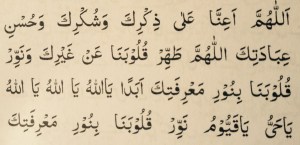
Religious polemics

Hadhrat Mawlana Mohammad Taqi Usmani (may Allah preserve him) reprimanded a murid,

“Stay away from all religious polemics.

Focus on the religious matters mutually agreed upon. These issues outnumber the ones that are disagreed upon.

There is no benefit in addressing the disputed issues, especially for the common lay individual. Discussing such issues is a total waste of time for him.

Only at an individual level if someone sincerely and for practical reasons wants to know the truth regarding these issues guide him to a reliable scholar or scholarly work.”

Mujazeen! Do not take baya or hold a majlis.

Hadhrat Mansur Ali Khan (may Allah preserve him) narrates that,

‘Arif-billah Hadhrat Dr. Abdul-Hayy ‘Arifi (may Allah have mercy on him) used to tell his mojazeen (those to whom he gave permission to take baya ‘and train murid) very firmly that until and unless they have an internal overwhelming yearning to take someone as a murid they should not take baya.

Similarly, without this intense inner desire to tell others about the spiritual path (tareeq) they should not open their mouth to give a speech. They should wait for their spiritual puberty and maturity.”

Recipe for success

Hadhrat Mansur Ali Khan (may Allah preserve him) narrates that Arif-billah Hadhrat Dr. Abdul-Hayy ‘Arifi (may Allah have mercy on him) used to say,

Do these things before embarking on any new or significant endeavor, inshaAllah, you will be successful.  Firstly, ask Allah for help and ease in initiating and completing it.  Then pray that it is done with sincerity (ikhlas) and truthfulness (sidq). And finally pray that it is accepted by Allah.”

Sin

Hadhrat Shaykh Masihullah Khan (may Allah have mercy on him) said,

“Never consider sin to be small. Regard sin as great. He who thinks slightly of sin has considered Allah to be insignificant.”

 The Path to Perfection, page 128

Deen and worldly benefits

Hakim al-Umma Hadhrat Mawlana Ashraf ‘Ali Thanawi (may Allah have mercy on him) said,

“Being influenced by worldly benefits in matter of religion (deen) is a sign of spiritual weakness. Religion is of utmost importance. It should be preserved. One should ignore all worldly benefits, even to the extent of annihilation of the Universe, in upholding it.”

Malfuzat, al-Ifazat al-yomiya min al-ifadat al-qomiya, volume 3, page 389

دین اور دنیوی مصالح

حکیم الامت حضرت مولانا اشرف علی تھانوی قدس سرہ نے فرمایا، 

” دین میں دنیوی مصالح سے متا‍ءثرہونا سب کمزوری کی باتیں ہیں۔

 بڑی چیز دین ہے۔ یہ محفوظ رہے،

 خواہ تمام مصالح بلکہ سارا عالم فنا ہو جاۓ کچھ پرواہ نہیں۔” 

ملفوظات الافاضات الیومیۃ من الافادات القومیۃ، ج 2، ص389،م 640

Signs of nisba

Hadhrat Shaykh Masihullah Khan (may Allah have mercy on him) said,

“The sign of existence of the servant’s relationship with Allah is his zeal to engage in obedience and worship as well as total abhorence for all forms of sin and disobedience -both outward and inward. In addition to this is the servant’s continuous determination to follow the Sunna.”

The Path to Perfection, page 112

Dowazdah Tasbih

dua

Hadhrat Mufti Mohammad Taqi Usmani (may Allah preserve him) instructed the following to a murid regarding the sufic dhikr of our tariqa: the dowazdah tasbih.

“Sit crossed-legged (on the prayer-mat facing qibla).

With the big toe and adjacent finger of the right foot grasp this tendon (rag e keymas) on the back of left thigh if easily possible. If this can be done, well and good, if it is not possible do not worry. Proceed with the dhikr.

Start with recitation of لا الہ with the head bend towards the heart and moving in the direction of the right shoulder. Imagining simultaneously that I am removing all other-than-Allah relationships from my heart and throwing them behind myself, when the movement of the head reaches the right shoulder.

Then while saying الا اللہ gently and swiftly move the head towards the qalb (heart) in a stroke (dharb) like manner. Contemplate simultaneously that the love of Allah is entering my qalb.

Do this recitation 200 times. Occasionally add محمد رسول اللہ صلی اللہ علیہ وسلم .

Then recite الا اللہ  400 times in a gentle audible voice with dharb as demonstrated. In the first 100 times concentrate on لا معبود الا اللہ (there is none worthy of worship except Allah). In the next 100 contemplate on لا مقصود الا اللہ (No one’s pleasure is desired except that of Allah). In the third 100 think on لا محبوب الا اللہ (there is none to be loved except Allah). And in the final 100 focus on لا موجود الا اللہ (in reality none exists except Allah).

Then recite  اللہ اللہ (first is with a paesh/dhamma and second with a jazam at the end) 600 times in a audible voice with stroking movements of the head as shown.

Finally, recite اللہ (with jazam) 100 times audibly and with dharb.

In these last two forms of dhikr try to focus on Allah’s being.

In total these are thirteen tasbihat (100s) but are commonly known as dowazdah tashib.

May Allah give us the nur and blessings in them. Ameen!”

Hadhrat demonstrated the recitation as described above by doing it himself. JazakAllah.

14th Zil-hajj 1411/27 June 1991, Old-Office, Darul Uloom Karachi.
Nisba & Wusul

Hadrat Shaykh Masihullah (may Allah have mercy on him) said,

Nisba literally means relationship or connection.

A relationship or a connection is a two-way process. In our context the relationship with Allah means Allah’s connection with the servant and the servant’s connection with Allah Most High.

The attainment of relationship with Allah (nisba) is also referred to as wusul ila’Llah.

The relationship of Allah with the servant is Allah’s pleasure with His servant. The relationship of the servant with Allah means the servant’s constant obedience and involvement in abundant remembrance with perfect awareness.”

The Path to Perfection, page 112

Suluk

Hadhrat Shaykh Masihullah Khan (may Allah have mercy on him) said, 

“The journey of suluk comprises two journeys: the journey towards Allah  (sayr ila’Llah) and the journey in Allah (sayr fi’Llah ).

The journey towards Allah  

This journey consists of two fundamental aspects.

One is the purification of the lower self (nafs) from egotistical ailments known as blame worthy character traits. Reference to this is made in the Qur’aanic verse, “Verily, he has attained success, who has purified his nafs.” 

And the other is adornment of the heart with praise worthy character traits. This is called tahliya and also tajaliya. In suluk this acquisition is described as stages (maqaamat). 

The journey in Allah

Upon having attained the stage of journey towards Allah, a special celestial radiance (jila) and light (nur) permeate the heart. The heart then is at all times dissociated from all things other than Allah. The heart is now truly occupied with Allah Most High.

In this high stage of spiritual development, matters pertaining to the Being of Allah (dhat), Attributes of Allah (sifat), Acts of Allah (af’al), and the Realities (haqaiq) as well as relationships between Allah and His servants become manifest. This then is termed journey in Allah.

In the realm of journey in Allah there are no limits. Progress is infinite. Progress is proportional and continuous in relation to one’s ability, occupation with Allah Most High and casting aside all motives, irrespective of wether such motives pertain to this world or the Hereafter. When one has attained this rank, one attributes nothing to oneself.”

The Path to Perfection, page 114-5

اصلی عید

عید گاہ ما غریباں کؤۓ تو

انبساط عید دیدن رؤۓ تو

صد ہلال عید قربانت کنم

اے ہلال عید ما ابرؤے تو

 حاجی صاحب رح

Joy of Eid!

On our eid visit to Hazrat Mawlana Mohammad Taqi Usmani (may Allah preserve him) we always found him to be extremely happy and cheerful, repeatedly telling us that Arifbillah Dr Abdul Hayy Arifi (may Allah have mercy on him) used to say regarding Eid al-fitr,

“We are excessively blessed individuals today!

All our sins have been forgiven.  All praise is for Allah, He exchanged them for good deeds. we are completely clean and tidy today.”