Tarbiyet

Shaykh Mawlana Shah Wasiullah Allahabadi (Allah have mercy on him) often used to cross-examine and challenge the spiritual aspirant by asking questions and making comments. This was for their tarbiyet. That is, inculcating deep in their mind a clear objective of the spiritual path and necessity to work sincerely and diligently for it. 

Some of these included,

‘Why do you people come here?

You have been staying here with me for so long what changes have you brought in your practical life?

What was discussed in the majlis today and what effect did it have on you? Every individual should write it down and give it to me.

You do not have yearning or reverence or respect of the Shaykh?

You do not have sincerity. In its place you have hypocrisy, diplomacy, manipulation, pretense and preference for the worldly. Therefore, your islah is difficult. You should go somewhere else. Why do you corrupt our place?

You have deficency of love or fear of Allah or regard for the Shariah’s grand status.

You display quiescence for the daily routine, a care-free and reluctant attitude, and heedlessness. Therefore, you should stay at your home and disseminate the effects of these things there. Why do you come here to do this?’

Halaat e Muslih al-Ummat ra, volume 2, page 17-8

Components of islah

Shaykh Wasiullah Allahabadi (Allah have mercy on him) said,

For islah (spiritual improvement, reformation, betterment) two things are essential.

One of them is instructions (ta’leem) and the other is training (tarbiyet).

The instructions are what you people do by this learning from books (lectures, etc.) from me. However, only instructions are not sufficient (for islah). They must be accompanied with training and spiritual cleansing (tazkia). It is for this that I bother you people and ask questions, admonish and catechize. This is the tazkia and tarbiyet’ (to acertain practical application of instructions given for successful achievement of islah).

Halaat e Muslih al-Ummat ra, volume 2, page 23 

Visiting other Shuyukh

Hakim al-Umma Mawlana Ashraf Ali Thanawi (Allah have mercy on him) said,

‘Previously it was my habit that where ever I went I visited the scholars and Shuyuk of that locality. This was irrespective of their spiritual demeanor(mashrub) . However, now after experience I do not do this any more. Moreover I advise my friends that doing this is dangerous. In the past people had goodness in their character now they have mischief. Nowadays instead of benefit harm is possible. Those who (continue) do so I find them to be confused most of the time. I receive many letters stating that since I visited so and so the state of my heart’s corruption is this.

A novice (mubtadi) should not meet different Shuyukh because it causes turbulence (in thoughts) and destroys the spiritual serenity (yuksui). Whereas, in this path (sulook) it is essential to maintain spiritual serenity and fortitude (jamiat e qalb). If they are destroyed (by visiting different Shuyukh), then of what benefit is this in the first place?’

Halaat e Muslih al-Ummat ra, volume 2, page 7-8

Regarding Tablighi Jamat

الدین النصیحہ

Instructions of Muslih al-Umma Shaykh Wasiullah (Allah have mercy on him) in particular to his associates and admirers and in general to all Muslims.

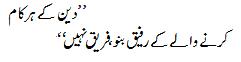
I have received information from various places and reliable sources that in some localities people are meddling with the Tablighi jamat. They neither perform  a work of deen themselves nor they allow others to do so by creating many obstacles in their task. I consider it to be a extremely bad thing that an individual neither does a work himself nor  he allows others to do so and in addition he makes so many objections on them that they are troubled and abandon the task itself.

The need of religious effort in this era is quite evident. It is vividly obvious that many people are required to do this task. It is well known that in every era there will be some servants of Allah who will serve the religion ardently and safeguard it with their soul and life. It is possible that there may be various different ways to fulfill this single purpose. Hence, in this era the truthful scholars (may Allah reward their effort) are doing this struggle to the best of their abilities.

Even if someone disagrees with a particular methodology the best thing to do is to continue working according to his own method to the best of his ability. However, he must also encourage, help and supplicate for the others working for the religion. If he comes to know about some of their lapses then wishing them well he should advise them politely.  He should neither abuse the Jamat itself nor blame their elders due to the slips of few individuals or lay people. I detest this extremely and consider it to be a source of fragmentation among Muslims.  This is not the time for such things. It is essential to make effort to create mutual love and friendship among Muslims and get rid of envy and enmity form their hearts. Mutual co-operation and unity are the stepping stone for any effective religious or secular endeavor.

It is for these reasons I instruct in general to all Muslims in particular to my associates and admirers that the should not meddle with any group  that is doing religious work (including the Tablighi jamat and others). Instead they should help and assist them. If they can not do so then they should at least supplicate for (Divine) good for them. This is because respected Mawlana Mohammad Ilyas (Allah have mercy on him) is from our elders. God-forbid, he is not an innovator or insincere individual, that his group be rejected and criticized.

As far as the issue of mistakes in the method of the newer generation is concerned it has come to my knowledge that the scholars and superiors of Jamat are aware of these. They are not negligent about these and will make effort on their own to make reformations. It should be none of of our concern to meddle with the effort of deen already taking place and unnecessarily open a new gate of calamity (fitnah) among Muslims.

In these perilous times I consider most minute of the  calamities (fitnah) to be fatal for Muslims. Therefore, I want to remain aloof from them and recommend my admires to do so. This is because the religion is to offer (beneficial) recommendation.

Halaat e Muslih al-Ummat ra,page, volume1, 376-7

——————–

Reason for not benefitting from khanqah!

An individual commented,

‘We have seen people who did not reform (islah) their lower self (nafs) staying in khanqah, however, those working in (Tablighi) jamat achieved this.’

Mawlana Abdur Rehman Jami khalifa mujaz e sohbet of Shaykh Wasiullah Allahbadi (Allah have mercy on them) replied,

‘The reasons why the reformation of an individual who stays in khanqah does not occur are;

 Either, that specific khanqah is not a reformative khanqah (to begin with)

Or the that individual is involved in practicing hypocrisy (nifaq e amli). He deceives the Shaykh and progresses only in his hypocrisy.’

Halaat e Muslih al-Ummat ra, page 370

Hypocrisy: a pretense of having a virtuous character, moral or religious beliefs or principles, etc., that one does not really possess.

Hypocrisy is the opposite of sincerity (ikhlas).

Request for dua

______________

أَذْهِبِ الْبَأْسَ رَبَّ النَّاسِ وَاشْفِ أَنْتَ الشَّافِي لَا شِفَاءَ إِلَّا شِفَاؤُكَ شِفَاءٌ لَا يُغَادِرُ سَقَمَاً

Please, make dua (supplications) for the health of sayyidi wa sanadi Mufti Mohammad Taqi Usmani (Allah preserve him).

JazakAllah.

____________

حضرت شیخ مدظلہ

_________

_____________

مرجع ارباب ھدایت، مركز دائرہ ولایت، مقتداے اصحاب شریعت، پیشواے ارباب طریقت

دلیل سبیل فلاح و رشاد، رھنماے طریق استقامت سداد

ھادی زمانہ، مرشد یگانہ،، غوث زماں، قطب دوراں

سراج المحبین، تاج المحبوبین، زبدة العارفین، عمدة الصلحاٗ و كاملین

عالم علوم ربانی، ماھر اسرار قرآنی، قدوة اصفیا، اشرف اولیاٗ

آیة من آیات اللہ، حضرت مولانا ‘مفتی الشاہ محمد تقی عثمانی’ صاحب

لازالت شموس فیوضھم بازغة و بدر مكارمہ طالعة

متعانا اللہ و جمیع المسلمین بطول حیاتہ و بقائہ

و نفعنا و سائر الطالبین باقوالہ و افعالہ

آمین

__________

حالات مصلح الامت رح، ص ٢٣٨، ‘’ تبدیل شدہ

__________

The epidemic!

_________________________

_________________________

Hakim al-Umma Shaykh Mawlana Ashraf Ali Thanawi (Allah have mercy on him) said:

The worst effect of committing sin is that due to the casual and careless attitude (of a sinner) a minor (saghirah) sin leads to a major (kabirah) sin and eventually to rejection of the truth (haqq). (That is, kufr).

Thus an individual should never become carefree after committing a sin. He should repent and make amendments.

Basa’ir-e-Hakeemul Ummat 532

A sin by definition is an act that displeases Allah.

How can any degree of displeasure of our Creator and Sustainer be considered to be minor, insignificant or a frivolous thing.

In our present environment we are involved in many activities that are sinful.  We observe, hear and think about  many things that are sinful. We consider them to be a normal indispensable part of our daily life.  We condone them. Most of the practicing Muslims are aware of the rulings regarding them but consider them to be trivial, insignificant and minor slips.

It must be remembered that nisbet e batini ( that is the goal of Tasawwuf: the real, strong, perpetual and mutually friendly relationship with Allah) is impossible with indulgence in any degree of sinful activity.

It is beyond common sense that any one will befriend an individual who considers the displeasure of his beloved to be insignificant, trivial and a casual thing.

At the least we must acknowledge our short comings, make repentance (isteghfara) and ask Allah for assistance in giving them up completely.

wa ma tawfiqi ila billah!

Spiritual discipline

Khawaja Farid uddin Masud  Shakar Ganj (Allah have mercy on him) (d. 1266 CE. Pakpattan) instructed his deputies (khulafa),

‘The spiritual progress lies in the discipline of the soul and the purification of inner self, and not in the mechanical performance of worship (only).

If marifat is desired, then anger, jealousy and hatred should be completely wiped out from the heart.

Religious knowledge and learning are pre-requisite  to spiritual discipline.”

Contribution of Mazahir-e-Uloom of Saharanpur to Tasawwuf, Dr Iffat Javed’s Ph.D thesis, Jamia Millia, Dehli, page 15 (edited)

سالک نہیں ہالک

_________________

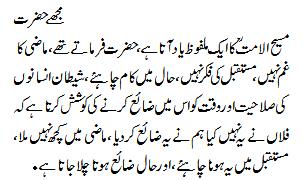
حضرت حکیم الامت مولانا اشرف علی تھانوی قدس اللہ سرہ نے فرمایا،

 لوگ اس طریق میں سالک ہونے کو بڑی چیز سمجھتے ہیں، مگر حقیقت یہ ہے کہ اصل چیز سالک ہونا نہیں، ہالک ہونا ہے،،

 یعنی اپنے کو مٹا دینا اور مٹا دینا بھی وہ معتبر ہے کہ اس مٹانے کو بھی مٹا دے کہ اس کی طرف کوئی التفات نہ ہو،

جیسے اصلی اور گہری نیند وہی ہے جس میں سونے والے کو اپنے سونے کی بھی خبر نہ رہے، ورنہ پھر وہ نیند نہیں، اس کو اونگھ کہیں گے ۔

 مولانا رومی نے خوب فرمایا
            فہم وخاطر تیز کردن نیست راہ
            جز شکستہ می نگیرد فضل شاہ

عشق

اول و آخر فنا ، باطن و ظاہر فنا
نقش کہن ہو کہ نو ، منزل آخر فنا
ہے مگر اس نقش ميں رنگ ثبات دوام
جس کو کيا ہو کسي مرد خدا نے تمام
مرد خدا کا عمل عشق سے صاحب فروغ
عشق ہے اصل حيات ، موت ہے اس پر حرام
تند و سبک سير ہے گرچہ زمانے کي رو
عشق خود اک سيل ہے ، سيل کو ليتاہے تھام
عشق کي تقويم ميں عصررواں کے سوا
اور زمانے بھي ہيں جن کا نہيں کوئي نام
عشق دم جبرئيل ، عشق دل مصطفي
عشق خدا کا رسول ، عشق خدا کا کلام
عشق کي مستي سے ہے پيکر گل تابناک
عشق ہے صہبائے خام ، عشق ہے کاس الکرام
عشق فقيہ حرم ، عشق امير جنود
عشق ہے ابن السبيل ، اس کے ہزاروں مقام
عشق کے مضراب سے نغمہ تار حيات
عشق سے نور حيات ، عشق سے نار حيات