Category Archives: N. Advice

How to develop concentration in salah?


.
Shaykh Mawlana Shah Wasiullah Allahabadi (Allah have mercy on him) said,

‘A lot of people inquire regarding concentration in salah. I tell them all try to develop concentration towards Allah outside salah, when this will increase then it will persist during salah also.

The pious elders improved their salah similarly. They recited wird for the development of concentration towards Allah in their hearts.
Therefore, all of them recited the blessed kalima لا اله الاالله محمد رسول الله excessively as a wird. This renews the faith and strengthens it.

In my opinion you should also recite it abundantly. InshaAllah, concentration towards Allah will develop in your heart and eventually persist in salah also.’

Majmua talifat Muslih al- Ummat, volume 3, page 41
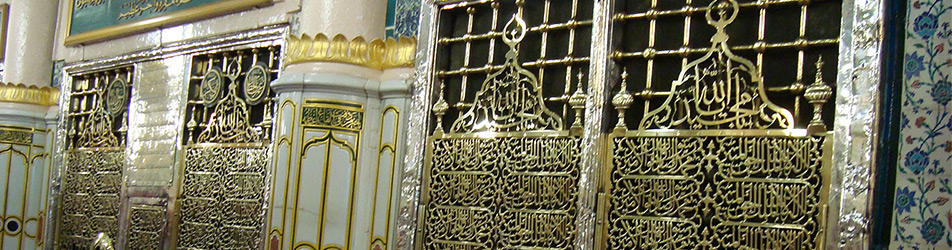
Medinah e munawwarah

Spiritual involvement

Shaykh al-Arab wal-Ajam Hadhrat Haji Imdadullah mohajir Makki (Allah have mercy on him) instructs a seeker,

‘After fulfilling the faraidh (absolutely essential), wajibat (highly recommended) and Sunna one should occupy his time in spiritual works of rectifying the condition of his heart (remembrance and contemplation) and not spend it in offering extra (nafil) salah or recitation of litanies. Instead he should consider the rectification of his heart to be a perpetual must (fardh) and never be negligent in it.’

Dhiya al-Qulub via Taleemud-deen, page 45

Remembrance of Allah

Qutub e ‘alam Shaykh al-mashaikh Mawlana Rasheed Ahmad Gangohi (Allah have mercy on him) wrote,

‘The remembrance of Allah (dhikr) is such a thing that if done consistently even with (non-volitional) unawareness, random thoughts, stress of worldly involvements merely with the movement of tongue then also it is beneficial and illuminates the qalb (heart).’

Madhmoon e dhikr, Majmua’ Talefat e Muslih al-Ummat ra, volume 3, page 6

Good of this world?

Shaykh Shah Wasiullah Allahabadi (Allah have mercy on him) said that,

‘The author of Ruh al-Ma’ani has explained the meaning of ‘good of this world’ as sound health and serenity (‘afiyet).’

What is ‘afiyet?

Our master Shaykh Ahmad Kabir Rifai (Allah have mercy on him) said,

‘Be considerate of the blessing of serenity. The reality of which is that the process of breathing continues without discomfort, the daily sustains is achieved without (much) hardship and the good actions are done without ostentation.”

Mujmua e talifat e Muslih al-ummat ra, volume 2, page 12-13

Tips to Alleviate Hardships

Hakim al-Umma Shaykh Ashraf Ali Thanawi (Allah have mercy on him) said,

 ‘Actions that diminish sufferings and hardships include:

– Recalling our transgressions (sin)

– Reminding ourself of the reward/compensation on hardships

– Reflecting that in hardship there is test of faith (‘eman). That is, it analyzes if there is faith present or not.

– Remembering, it causes a state of overwhelming slave-hood (abdiyat). The dirt of self-assertion, arrogance and pride is cleansed. The reality of one’s being is revealed and the person realizes not to make any boastful claims.

– Bringing to mind that it causes one to perceive the supremacy and grandeur of Allah’s actions and one’s own feebleness.

Hence, hardships result in increasing slave hood (abdiyat). And the abdiyat is a very distinguished state (maqam).”

Ma’asir Hakeemul Ummat, page 390-1

The objective

Shaykh Abdul Qudoos Gangohi (Allah have mercy on him) advised,

‘It must be understood very clearly  that the objective of acquiring knowledge is to act accordingly.

On the Day of Judgement  the inquiry will be about  the actions performed not regarding the extent of one’s knowledge.

The aim of these actions is to acquire sincerity and love of Allah.’

Maktubat e Qudoosi, via Tareekh Mashaikh e Chisht, volume 1, page 259

Arrogance & Humility

—————

‘O Ahmad!

Arrogance is a thing to be discarded, and humility is desired.

Arrogance reflects envy, and humility attracts friendship.

Arrogance is hideous, and humility is beautiful.

Arrogance leads to hatred, and humility brings forth love.

Arrogance is the behavior of niggards, and humility is the attribute of the noble.

Arrogance dissolves friendships, and humility strengthens them.

Arrogance is (one of the) most  evil moral traits in men and women.

O Ahmad!

It is narrated by Ibn e Abbas (Allah be pleased with them) that

I am bewildered by the state of an individual

who has passed through the urinary outlet twice* and displays arrogance. ‘

Mulhemat of Shaykh Jamaluddin Ahmad Hansvi (Allah have mercy on him), page 41-43

(*First as a sperm and then as a newborn.)

——————–

Doubts!

A reader wrote,

Assalamualaikum wa rahmatullahi wa barakatuhu.

I need some clarifications:-

I always have doubts about the akabir of Deoband. That is,  I want to know regarding the negative words that Barelwis spread about Moulana Ashraf Ali Thanvi.(rahmatullah alaih) and other akabir ulema. I respect the akabir of Deoband very much for their knowledge but after hearing the negative things about Deobandis, my heart is always in suspicion about the honesty of Deobandis.

Please,Please…. help!

And sorry for asking such questions.

Jazakallah hu khairaa.

Following reply was sent. (InshaAllah it will be beneficial to all of us.)

Bismillah
 
Respected brother  
as salam o alaykum wrwb
 
JazakAllah.
 
There are two answers for your question.
First is the ilzami (accusatory) and other islahi (reformative).
 
The ilzami answer is that why don’t you have doubts and suspicions about the Baraelwi comments being corrupt, false, dishonest, thimblerig & politically motivated. If you can give me some reason then we might have a discussion.  The upshot of this answer is how do you as an individual lay person can judge between the two groups?

Our akabir have taught us this, “A murid complained that when people talk negatively about you it hurts me and my heart aches.
Hakim al-Umma Mawlana Shah Ashraf Ali Thanawi (Allah have mercy on him) replied;
‘There are a multitude of people who talk badly about Allah, His messenger (blessings and peace of Allah be upon him) and the  scholars (mujtahideen). Have you done any thing to stop that?
If not, then why does it hurt you when poor Ashraf Ali is censured.  And you feel concerned about stopping this?
There is nothing in this attitude except kibir (arrogance).
It annoys you when your seniors are censured. You feel humiliated at this. This is a hidden deception of nafs (ego/lower self).
Suppose, even if it is not kibir (arrogance). Then I ask, why did you feel concerned about anyone  saying any thing good or bad (regarding my seniors).
What harm did it cause to you?
If you had focused on the goal (of tareeq, i.e. seeking perpetual pleasure of Allah ) you could not have time to waste on these petty issues.

Hakeemul Ummat ra kay hayret-angez waqiyat, page 81

 
The islahi answer is for the truth seeking sincere individual. May Allah make us both from them.Amin!
(Your openness to come forward and ask this is itself a sign of seeking the truth. MashaAllah.)
 
First it must be very clear that we are bound to follow Sunnah meticulously. Following Hakim al-Umma Mawlana Ashraf Ali Thanawi (Allah have mercy on him) or Molvi Ahmad Raza Khan sahib is not an obligation. We won’t be questioned in here-after regarding this. If the following of Sunnah(both, external and inner) is facilitated through their teachings well and good. If not then you have to look somewhere else.
 
(Alhumdulliah, I have personally benefited a lot from the teachings of Hakim al-Umma in bringing deen into my life to a degree. May Allah allow me to benefit more. Amin! Similarly I have read about and seen personally lot of people who changed their life for better by following his teachings.)
 
Having doubts is natural phenomenon. However, being affected to the degree to actively suspect and consider another Muslim (irrespective of him being a pious, learned scholar/sufi)  to be intentionally dishonest is blame-worthy condition (bad-gumani, keyna, etc.) . There should be explicit proof for this.
 
It is usually a result of keeping company with people who have this already in them and are lax on issue of ghibet/bad-gumani/hifazet-e-lisan/etc., and/or lack of knowledge and being involved in useless.
Being sins their darkness clouds the perception of truth. This can only be lifted by repentance and resulting Divine enlightenment.

The teaching of our pious master is,
 
کفر است در طریقت ما کینہ داشتن

آ‏‏ئین ما است سینہ چوں آئینہ داشتن
 
Please, make excessive supplication, keep your focus on the following of Sunna and consult your Shaykh for the cure of these potentially fatal spiritual ailments.
 
For the time being the best things to do  will be,
1. Avoid all useless discussions.
 
2. Try your best to follow Sunnah meticulously in each and every aspect of your life.
 
3. Make dua excessively. Ask Allah SWT for guidance. Especially set 10 minutes daily after ‘esha salat and make dua for your own islah, isteqamat and correct understanding of deen.
 
4.If you lack information then please, read the book ‘Aqaid e Ulemae Deoband aur Hassam ul Haramain’. It is  in Urdu and available online.

 
5. Even after all these measure if the doubt and suspicion persist then the best thing will be to ignore both the groups and follow the Sunnah and scholars who affiliate with none of these groups. It is best to remind ourselves that it is a fitnah by definition when truth can not be distinguished  and things become suspicious. The best strategy as per Prophet (Allah bless and grant him peace) is to keep ourselves completely aloof from it.
 
I pray and hope that my rambling makes sense to you. If there are any question, please, do not hesitate to ask. The benefit is mutual. JazakAllah.

Take care.
Please, do try to make dua for me.
muhtaj
Sunnah of Friday

Sunnah of the Day

The Path of Sunnah is the Path to Jannah

Sunnahs of Jumuah

1.        To take a bath.

2.        To wear nice and clean clothes.

3.        To proceed early to the Masjid.

4.        To go to the Masjid on foot.

5.        To try to sit as close as possible to the Imaam.

6.        If the Saffs (rows) are already filled, one should not jump over the shoulders of the musallies in order to get to the front.

7.        One should not do any futile action eg. one should not fiddle with one’s clothes or fingers.

8.        To listen to the Khutba attentively.

9.        The person who recites Surah Kahaf on Friday will be bestowed with a Noor( Spiritual light) from under the Arsh (The Throne of Allah Ta’ala) which will extend from the earth till the sky and will benefit him in the darkness of the Day of Qiyaamah. All his (minor) sins which he had committed from the previous Jumu’ah up to this Jumu’ah will be forgiven.

10.     Rasulullah (Allah’s blessings and peace be upon him) is reported to have said, “Recite Durood upon me in abundance on the day of Jumua’h since they are presented to me.”

11.     On the day of Jumua’h it is Sunnat to apply oil to the hair and to use it or any other sweet smelling fragrance.

Tip on adding something new to our daily routine

__________

It is a common every day incident that we read or hear something that is virtuous and a blessing to be in-cooperated into one’s daily routine. However, in addition to forgetfulness we find it difficult to spare an additional time slot for this small endeavor in our daily schedule.

Sayyid wa sanadi Shaykh Mufti Mohammad Taqi Usmani (Allah preserve him) instructed,

‘The tip to include something new in your daily routine is to squeeze it between two already established chores.’

___________

___________

Secret of repitition

‘Arif-billah Hadhrat Dr Abdul Hayy ‘Arifi (may Allah have mercy on him) said,

“Reading or discussing something repeatedly usually results in recalling it when its need arises.

At that moment one needs spiritual determination to act according to it.

Doing such for some time eventually leads to the creation of an instinctive inclination for acting so without effort.”

Malfoozar e Arifi 167