Category Archives: S. Sunna

Time management

Arif-billah Dr Abdul Hayy Arifi (Allah have mercy on him) said,

‘Time management is part of the Shariah.

The manner in which Prophet (Allah bless him and grant him peace) used to divide his time is explicitly reported in a tradition quoted in (the book) Shamail e Tirmizi.

That is, when at home Prophet (Allah bless him and grant him peace) used to divide his time into three parts. The first one was for worship of Allah. The second for his wives (and other household members). The third for his special Companions.’

Shu’b al Eman via Isha al Muslimeen, page 411

Hajj: which category?

The Prophet (Allah bless him and grant him peace) once said,

“Near the time of Qiyamah the rich people from my Ummah will perform Hajj for the sake of travel and holiday (like having a holiday in Hijaaz instead of one in London or Paris).

The middle class will perform Hajj for commercial purposes, thereby transporting goods from here to there while bringing commercial goods from there to here.

The scholars will perform Hajj for the sake of show and fame; (to outdo and surpass so and so scholar, or any rival shaykh who had performed Hajj a certain number of times).

The poor will perform Hajj for the purpose of begging.” (Kanzul Ummaal)

Virtues of Hajj, page 7

Managing time

Hakim al Umma Mawlana Ashraf ‘Ali Thanawi (Allah have mercy on him) said,

‘Time management and planning how to to do so are a great things.

It should not be the way to do something in the time allocated for another thing and do that particular thing in some other time slot.

Everything should be done in the time set for it.

This brings great blessings (barakah) in time (more things are done with ease in same duration) and comfort (to all).’

Husn al Aziz, volume 2, page 412

Prepare for Ramadhan

1. Ask Allah for facilitation (tawfeeq) to benefit from the blessings of Ramadan daily, from now onwards.

2. Make a firm determination to abstain from all sins. Especially those committed by the eyes, ears and tongue.

3. Try to free as much time as possible from work and other commitments for pure worship (ibadah).

4. Reschedule non essential appointments till after or before Ramadan. Finish all Ramadan and Eid shopping prior to the sighting of the crescent.

5. Make special effort to follow as many as possible Sunna in daily activities.
Learn these and memorize the adiya e masnoon (dua) for particular occasions before hand. The book “Alaikum bi sunnati”by Mawlana Abdul Hakim Sukharwi ra is a good, practical and handy resource for this.

6. Review the essential fiqh (rulings) relating to fasting, taraweeh and other Ramadan related issues from “Behishti Zewar” (Heavenly Ornaments) of Hakim al-Umma Mawlana Ashraf Ali Thanawi (may Allah have mercy on him).

7. To get motivated and organized, read the discourses of Hakeem al -Umma regarding Ramadan (Mawaiz-e-Ashrafiya volume : Barakat e Ramadan) and listen to the talks of Sayyidi wa sandi db on how to prepare for the holy month.

8. Practice the actions of the Heart. Do not do any action without a proper intention.Abstain from all the blame worthy morals. No anger, arrogance, belittling caustic remarks, etc. It is strange to abstain from otherwise halal (lawful food) and commit an act which is always haram (forbidden). Try to do most of the praise worthy moral actions. Having patience, humility, gratitude, sincerity, etc. Keep a tight grip. Do not slip here.

9. Make a practical and doable time table for daily activities.

The point to remember is that in Ramadan acts of primary form of worships (i.e. salah, dhikr, tilawat, etc.) are to be increased. These lead to an increasing direct relationship with Allah  (i.e. ta’luq ma’Allah).

The tawfiq is from Allah!
Those at loss in middle Night of Sha’ban

Our master Prophet Muhammad, (Allah’s blessings and peace be upon him) said,

“This is the middle Night of Sha’ban. Allah frees in it a large number of the people from (Hell) Fire, more than the number of the hairs growing on the sheep of the tribe, Kalb. But He does not even look at an individual who

– associates partners with Allah, or

– who nourishes malice in his heart (against someone), or

– who cuts off the ties of kinship (qata’ rehmi), or

– who leaves his clothes extending beyond his ankles (as a sign of pride), or

– who disobeys his parents, or

– who has a habit of drinking wine.”

Allah save us from being among these individuals. Amin!

Leaving what does not concern us

“The Messenger of Allah (Allah bless him and give him peace) said,

“From the excellence of a man’s Islam is leaving that which does not concern him.”

“That is, to leave that which is not important or befitting of him, whether in speech, actions, or thought.

Thus, ‘the excellence of a man’s Islam’ is its perfection, such that one remains steadfast in the submission to the commands and prohibitions of Allah, and surrenders to His rulings in accordance to His destiny and decree (qada wa qadr). This is the sign of the heart having been expanded by the light of its Lord, and the descent of quietude (sakina) into the heart. The reality of ‘that which does not concern him’ is that which is not needed for a worldly or next-worldly necessity, and does not aid in attaining his Lord’s good pleasure, such that it is possible to live without it…

This includes excess acts and unnecessary speech… This hadith may well be taken from Allah Most High’s saying,

“And who shun all vain things.” (Qur’an, 23: 3)

Mulla Ali al-Qari (Allah have mercy on him) mentioned this in his commentary on Mishkat al-Masabih.

Riyadh,KSA

Following the Sunna

Grand Mufti of Pakistan, Hadhrat Mufti Mohammad Shafi’i (may Allah have mercy on him) said,

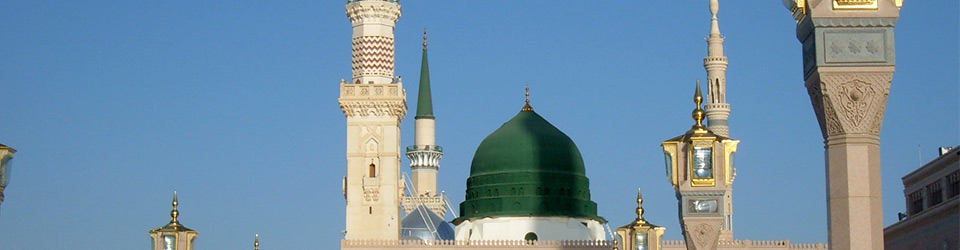
In the presence of Prophet (may Allah bless him and grant him peace) while visiting the Holy mosque at Medinah e munawwara, I felt as though the Prophet (may Allah bless him and grant him peace) is saying,

“Being nearer to me is in following my sunna. It is not in coming here.

As much you follow me the nearer you come (to me).”

Ahsan us Sawanih, page 157

Improve our salah

One of the attendees requested for a premature departure  Shaikh Haji Shakeel Ahmed (Allah preserve him) humbly asked him to wait few minutes to listen to what he had to say. Then he briefly advised,

‘It should be crystal clear that if we do not improve our salah we will not be able to improve our (spiritual) life.

On the Day of Judgment Allah will not question us about the time spent in Tableegh, or Khanqah or education (madersa). The very first question will be regarding the salah. The foremost thing we will be accountable for will be our salah.

If we are questioned about our salah now, we will be dissatisfied ourselves. Then how could this salah please Allah.’

11/8, MC1, KKNGH, Jeddah, 02 June 2012,  after esha

Advice to the graduating scholars: Necessity of moral discipline

Addressing the final session of the Hadith text Sahih al Bukhari sayyidi wa sanadi Shaikh Mufti Mohammad Taqi Usmani (Allah preserve him) emphasized on the necessity of moral discipline. This is essential to make our actions worthy of reward as Imam Bukhari (Allah have mercy on him) has alluded to in the closing chapter on his book. He said,

‘The acquistion of the fine equilibrium required for moral characteristics of an individual as recommended by the standards of Quran and Sunna is possible (only) by being in the company of the pious (ahlul Allah) (for this specific purpose) and effacing one’s self (nafs, eccentric ideas, impermissible desires, boastful expectations, etc.)  in front of them.’

Khatam e Bukhari sharif 1433, Darul Uloom Karachi approx 43mins onwards

Improving salah

Shaikh Haji Shakeel Ahmed (Allah preserve him) said,

‘A very senior pious individual instructed me that if I was seriously interested in becoming religious than I should be vigilant about improving my salah. That is, praying salah as per Sunna with contemplation that Allah is watching me. He added that if I did not do this than in spite of praying punctually I will be simultaneously doing all the undesirable worldly stuff.

Haji sahib instructed to those present to not to take this lightly. Improving salah should be our topmost priority.

Moreover, he emphasized reading the booklet ‘Namazain Sunnat kay mutabeq parhyay’ by sayyidi wa sanadi Mufti Mohammad Taqi Usmani (Allah preserve him) carefully and meticulously implementing each and every step as instructed. ’

11/8, MC1, KKNGH, Jeddah, 02 June 2012,  after esha

Maintain wudhu

Shaikh Haji Shakeel Ahmed (Allah preserve him) said,

The trustworthy and truthful messenger of Allah Prophet Mohammed (Allah bless him and grant him peace) told us that wudhu is a weapon of a believer.

In reality it is a spiritual hidden armament against the ploys of lower self (nafs) and Satan.

We should be vigilant in maintaining it.

Unhealthy habit of chewing pan, smoking cigarettes and drinking carbonated drinks makes it difficult to maintain wudhu most of the time. We should abandon them.

Moreover, the Prophet (Allah bless him and grant him peace) himself stayed in the state of wudhu most of the time. We should emulate his blessed sunna.’

Jeddah, al-Azizia 30th May 2012, bayan after maghrib