Category Archives: S. Sunna

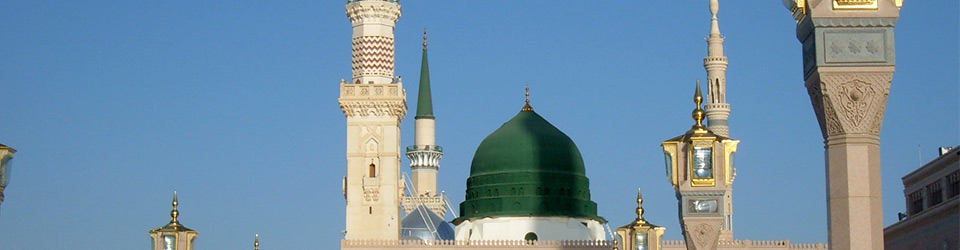
Etiquette of Haramain Sharifain

20130925-120127.jpg

Every Muslim desires to visit the blessed and radiant cities of Makkah and Medinah (Haramain sharifain: the noble sanctuaries). At least once in his lifetime.

For many this opportunity comes with the performance of Hajj. Others get this chance when they visit for Umrah. Sometimes repeatedly.  Few individuals are blessed to get jobs in these cities and earn their living there.

All of these moments spend in the noble sanctuaries are extremely precious. A virtuous deed done in these precincts can earn a reward of 50,000 to 100,000 times performed elsewhere.  An unimaginable bonus!

Each and very second has to be utilized effectively to reap maximum benefit. A challenging task indeed. Especially, for individuals like us who are not organized and motivated. Laziness, apathy and negligence become the major barriers.  Moreover, committing sinful acts in these sanctuaries are  reciprocally or extra-reprehensible and blameworthy.

It is for these reasons some pious scholars have advised against taking permanent or prolonged residence in these noble  sanctuaries. They include our Imam Abu Hanifa (Allah have mercy on him).

Shaikh Haji Imdadullah mohajir Makki (Allah have mercy on him) advised an Indian  nawwab planning to migrate to Hijaz,

‘Staying in Hindustan and having a desire to live in noble sanctuaries is better than living here and being occupied in your stately affairs in Hindustan.’

Shaikhul Hadith Mawlana Zakariya mohajir Madani (Allah have mercy on him) use to tell those expressing their desire to migrate to Medinah e munawwarah,

‘Do not make such a decision of migration by observing my example. I have come here (towards the end of my life) to die (and be buried in Baqi).’

In short, the etiquette of the noble sanctuaries are significant and have to be taken very seriously.

The interview: Medinah e munawwarah 19th Ziqada 1434


Condemnation of attack on Christians in Pakistan

 012

Shaikhul Hadith Mawlana Zakariya mohajir Madani  (Allah have mercy on him) said,

‘In fact the matter concerning dhimmis  (ذمی) in these affairs (i.e. rights of Non-Muslims living in an Islamic state) is far more serious than that of Muslims.

The Prophet (blessings and peace of Allah be upon him) said in this regards,

‘He who oppresses any Dhimmi, or defames and degrades him, or demands from him anything more than he can bear or do, I will stand against that person and make demand in favor of that dhimmi on the Day of Judgemnent.’

This is truly a very serious matter and a point worthy of great concern.

At the most critical moment (on the Day of Judgement) ones’s own attorney and defendant (the Prophet, blessings and peace of Allah be upon him) becomes the prosecutor. How tragic this situation can be?

‘My Pakistani friends must be very cautious regarding this as the non-Muslim (living) there are Dhimmis in all respect.’

Prescribed Preliminary Practices, page 5-6

Shaih al Bukhari , Volume 9, Book 83, Number 49: 

Narrated ‘Abdullah bin ‘Amr:

The Prophet said, “Whoever killed a Mu’ahid (a person who is granted           the pledge of protection by the Muslims) shall not smell the fragrance          of Paradise though its fragrance can be smelt at a distance of forty           years (of traveling).”

012

Medinah al munawwarah

Love of the Prophet (blessings and peace of Allah be upon him)

20130922-165601.jpg

A hundred thousand greetings, salutations and honorable congratulations be upon the pure tomb of the head to the throne of the Law, the full moon of the firmament, the sun of the constellation of reality, the crown upon the head of the the mystics, the chief of the prophets, the one intimate to the secret of “He revealed to His servant what He revealed” (53:10), the one breathing the fragrant air of the garden of the station of “at two bows length or bearer” (53:9), Muhammad, the Apostle of Allah- the blessings and peace of Allah be upon him and upon all his family members, friends , descendants and followers.’

[Ma’din ul Ma’ani, page 2]

The Prophet (blessings and peace of Allah be upon him) said,

“None of you believes until he loves me more than he loves his children, his parents, and all people.”

(Sahih Bukhari and Muslim)

Freedom from hypocrisy

20130916-103510.jpg

حدثنا عبد الله حدثني أبي ثنا الحكم بن موسى قال أبو عبد الرحمن عبد الله وسمعته أنا من الحكم بن موسى ثنا عبد الرحمن بن أبي الرجال عن نبيط بن عمرو عن أنس بن مالك عن النبي صلى الله عليه و سلم انه قال :
من صلى في مسجدي أربعين صلاة لا يفوته صلاة كتبت له براءة من النار ونجاة من العذاب وبريء من النفاق
تعليق شعيب الأرنؤوط : إسناده ضعيف لجهالة نبيط بن عمر

Anas ibn Malik (Allah be pleased with him) says that the Prophet (Allah bless him and give him peace) said:
Whoever prays forty salah in my mosque (Masjid an-Nabawi) without missing a salah in between them, then freedom from the hellfire, escape from punishment, and freedom from hypocrisy will be written for him”

(Musnad Ahmed)

The chain of this Hadith has been classified as weak by Muhaddithun.
Nevertheless, it is considered mustahab to offer the forty prayers in Masjid an-Nabawi.

Arif billah Dr Abdul Hayy ‘Arifi (Allah have mercy on him) said,
‘Acting on mustahibat is a calling of love (muhabbat).’

Criteria for spouse selection

20130914-182649.jpg

The Prophet (Allah bless him and give him peace) said,

Do not marry women due to their beauty and elegance. It is possible that this beauty and elegance leads them to the path of destruction.

Do not marry them because of their wealth.
It is possible that their wealth leads to transgression and involvement in sinful.

Instead marry them on the basis of their religious state (Deen).

A black slave girl who is religious and endowed with good manners (ikhlaq) is better than a beautiful women from a notable family who has bad manners (ikhlaq.).
Ibn e Majjah via Uswa e Rasool e Akram Allah bless him and give him peace) , page 662

For those visiting Medinah e munawwarah

book1It is highly recommended that those individuals who are proceeding to the radiant blessed city of Medinah have this book with them.

Thorough reading with intention to follow each and every Sunna must be done. The reading should be organized in such a manner that whole book is completed in their stay. It will bring much blessings and save them from wasting time in idle talk and involvement in suspicious or sinful activity.

As per sayyidi wa sanadi Mufti Mohammad Taqi Usmani (Allah preserve him) the memorization of the Prophetic prayer wordings in Arabic must be done. These wordings have their own barakah and radiance.

Insha Allah, this will increase the chances of their visitation to be accepted.

wa ma taufiqi illah billah!

Get organized

20130820-135148.jpg

Towards the end of Ramadan a seeker called and lamented about not being able to utilize the precious moments effectively.

Sayyidi wa sanadi Mufti Mohammad Taqi Usmani (Allah preserve him and allow us to benefit from him immensely, Amin!) was obviously annoyed. He replied,

‘For a long duration you have lamented about the same problem.
That is, not being able to do what is instructed and required for a seeker. Until and unless you organize yourself and manage time properly you will continue to do so.

Make a decision. Either you plan and get organized or leave this path (of islah).

Do not lament!’

Ramadan 1434, after dhur, office.

In “Dasturul amal baraay talibeen e islah” it has been made very clear that if an individual is willing to spare the time and follow the instructions (including the daily recommeded recitation, etc.) only then he should commit and proceed for islah. Committing and then being lazy results in great loss of blessings. Also, it wastes time, especially for the Shaikh.

Eid: An unimaginable joy!

20130808-184649.jpg

The Prophet of Allah (Allah bless him and give him peace) said,

“On the day of eid (when people gather to offer eid prayers)
Allah says to the Angels,
‘Have these people fulfilled the obligation (of fasting)
and are now gathered for prayers?

I swear by My pride, magnificence, majesty, mercy and elevated status that I will fulfill their prayers.

Tell them to return,
I have forgiven them all
and furthermore
I have replaced their sins with virtuous deeds.

Hence they return completely forgiven.

(Mishkat/Bahaiqi)

On our eid visit to Sayyidi wa sanadi Mawlana Mohammad Taqi Usmani (Allah preserve him) we always found him to be extremely happy and cheerful, repeatedly telling usArifbillah Dr Abdul Hayy Arifi (Allah have mercy on him)’s saying regarding Eidul fitr

“We are excessively blessed individuals today.

All our sins have been forgiven.

They have been bartered with good deeds.

We are completely clean and tidy.”

An unimaginable joy!

Those at loss on the night of 15th Sha’ban

20130623-181152.jpg

It was reported from our master Prophet Muhammad, (Allah’s blessings and peace be upon him),

“This is the middle Night of Sha’ban. Allah frees in it a large number of the people from (Hell) Fire, more than the number of the hairs growing on the sheep of the tribe, Kalb. But He does not even look at an individual who

– associates partners with Allah, or

– who nourishes malice in his heart (against someone), or

– who cuts off the ties of kinship (qata’ rehmi), or

– who leaves his clothes extending beyond his ankles (as a sign of pride), or

– who disobeys his parents, or

– who has a habit of drinking wine.”

Allah save us from being among these individuals. Amin!

Dua for Night of 15th Shaban

20130623-180248.jpg

Following supplications has been reported from the Prophetic sayings,

اللَّهُمَّ إِنِّي أَعُوذُ بِعَفْوِكَ مِنْ عِقَابِكَ , وَأَعُوذُ بِرِضَاكَ مِنْ سَخَطِكَ , وَأَعُوذُ بِكَ مِنْكَ , لا أُحْصِي ثَنَاءً عَلَيْكَ أَنْتَ كَمَا أَثْنَيْتَ عَلَى نَفْسِكَ

The following supplication has been recited by the pious elders on this occasion. Surah Yaseen (chapter 36) is recited three times. Each time it is followed by this supplication.

20130623-174512.jpg

Sayyidi wa sanadi Mufti Mohammad Taqi Usmani (Allah preserve him) wrote the following regarding the worship in the night of 15th of Sha’ban,

“This night is meant for worshiping Allah in solitude.
It is the time to enjoy the direct contact with the Lord of the Universe, and to devote one’s attention to Him and Him alone.
These are the precious hours of the night in which nobody should intervene between one and his Lord, and one should turn to Allah with total concentration, not disturbed or interrupted by any one else.”

Two rakat prior to maghrib salah

20130506-083308.jpg

Sayyidi wa sanadi Mufti Mohammad Taqi Usmani (Allah preserve him with ‘afiyet) said in discussion regarding the permissibility of praying two rakah prior to the fardh salah of maghrib,

The correct and just thing is that there is no proof (daleel) of two rakah prior to maghrib being disliked (karahiyet). And there are many proofs of its permissibility.

However, it must be taken into account that at places where there is time interval prior to congregational salah (jamah), like in the blessed Haramain, then being stubborn that I am a Hanafi and whatever happens I am not going to pray is not the proper attitude. In these situation it should be offered.

One thing that has to be always avoided is: creating fitnah.

Praying these two rakah are permissible and wherever there is time available (between adhan and jama’h) they should be offered. However, it should not be offered at places where none has even heard about this issue. Initiating these prayer in this situation will create a fitnah resulting in useless discussions.
However, mention the permissibility of this issue at an appropriate opportunity.

Inman al Bari, volume 3, pages383-5