


_____________________
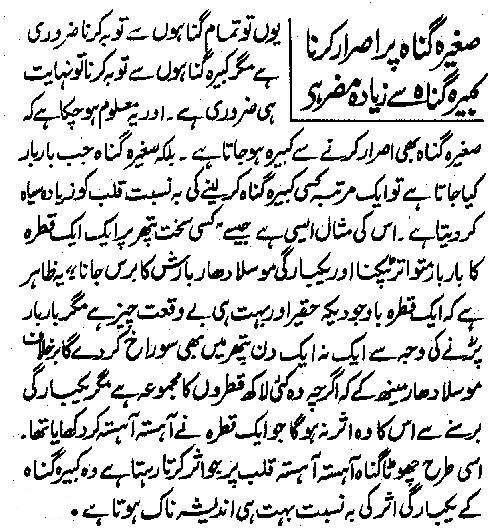
امام غزالی رح، تبلیغ دین ص 235

Sayyidi wa sanadi Shaykh Mufti Mohammad Taqi Usmani (Allah preserve him) advised a murid;
“Do physical exercise/workout daily.
Perform it, irrespective of the kind it may be or for how long you do it.
This is an obligation on you for (maintaining the physical well being of) your body.”
Malfoozat; Kebriyet e Ahmer,by Dr Syed Abdul Qadir Ahmer sahib db, page 11, # 47

Hakim al-Umma Mawlana Ashraf ‘Ali Thanawi (Allah have mercy on him) said,
‘My respected teacher Mawlana Yaqub Nanotawi (Allah have mercy on him) used to advice the seekers that they should end their routine activities (wird, tilawat, tasbihat, readings, etc.) before they loose complete interest in them. Leaving a desire to still do more. If they do not do this they will have a burnout (experience of long-term exhaustion and diminished interest) eventually.
Allah save us all form this.
To make it easier to understand he gave the example of yo-yo (Urdu:chakai/chukdor). The tip for successful play is to pull the string before it unwinds completely. If it were to unwind totally the yo-yo spool will never return and just dangle there aimlessly.
Similar is the tip for a salik (and the instructing murshid) to keep the flame of interest and desire burning.
Undertaking too much, too quickly with drastic lifestyle changes over a short period of time is usually spiritually unhealthy.
The natural spiritual growth is slow, continuous and imperceptible process. Just like the physical development. Years and decades are required to reach and manifest the signs of spiritual puberty and maturity.
A perfect murshid (Shaykh-e-kamil) is needed for this reason.
(Paraphrased. Malfuz reported in Majalis e Hakim al-Ummat ra, and repeated many times by sayyidi wa sanadi wa murshidi Mufti Mohammad Taqi Usmani (Allah preserve him) in his discourses.)

Giving instructions to a newly appointed mujaz sayyidi wa sanadi Shaykh Mufti Taqi Usmani (Allah preserve him) said,
The first and most essential thing is,
1. Never to be negligent of one’s own islah.’
Hidayet baraay e mujazeen
This reality has to be realized that islah never ends.
It is an ongoing process.

A murid complained that when people talk negatively about you it hurts me and my heart aches.
Hakim al Umma Mawlana Shah Ashraf Ali Thanawi (Allah have mercy on him) replied;
‘There are a multitude of people who talk badly about Allah, His messenger (blessings and peace of Allah be upon him) and the scholars (mujtahideen). Have you done any thing to stop that?
If not, then why does it hurt you when poor Ashraf Ali is censured. And you feel concerned about stopping this?
There is nothing in this attitude except kibir (arrogance).
It annoys you when your seniors are censured. You feel humiliated at this. This is a hidden deception of nafs (ego/lower self).
Suppose, even if it is not kibir (arrogance). Then I ask, why did you feel concerned about anyone saying any thing good or bad (regarding my seniors).
What harm did it cause to you?
If you had focused on the goal (of tareeq, i.e. seeking perpetual pleasure of Allah SWT) you could not have time to waste on these petty issues.
Hakeemul Ummat ra kay hayret-angez waqiyat, page 81

lmam Ghazali has reported from our master Hasan Basri (Allah have mercy on them) a narrative that Satan said:
“I presented sinful deeds in an attactive form to the Muslims, but they nullified my efforts through repentance (istighfar). Then I presented before them vices in the garb of virtues, thus leaving no initiative for repentance.”
Instances of such vices are self-made innovations (bidah) in religious practices.
Vitues of Zikr, page 133

Shahykh Shah Wasiullah (Allah have mercy on him) said,
‘Are you aware of the reason that why some of the people who come here (for islah &ta’aluq maAllah) do not benefit?
The reason is that this path (tariq) essentially requires propriety (adab) and reverence (aqidat).
People consider this path to be similar to the conditions in secular schools where a tutor teaches and the pupil learn irrespective of having any reverence for him. The student learns even if he does not show any respect to the teacher.
They consider that the teaching in Tasawwuf is also like this and there is no need of reverence and propriety towards the Shaykh.
Shaykh’s instructions are considered to be beneficial and are memorized, however, there is no reverence for the Shaykh in their heart. It is for this reason that they do not benefit.
It is as though Tasawwuf is now considered to be another branch of science and arts. In reality, it is a practical and experiential entity.
Hakim al-Umma Mawlana Ashraf Ali Thanawi (Allah have mercy on him) told us multiple times that if someone questioned Shaykh Haji Imdadullah mohajir Makki (Allah have mercy on him) regarding an issue (mas’ala) of Tasawwuf. He used to admonish the inquirer and tell him that this is not a school (maderasa) whenever (a need is felt and) I find it appropriate I will explain it.’
Taharet e qalb, Nifaq ka bayan, page 83

The honorable Companion Huzaifah (Allah be pleased with him) narrates that the Prophet of Allah (blessings and peace of Allah be upon him) said:
“It is not proper for a Believer to disgrace himself.”
It was asked: “O Prophet of Allah ! What is meant by this?”
The Prophet of Allah (blessings and peace of Allah be upon him) said: “To undertake something which you cannot bear.” (Tirmizi)
Hakim al-Umma Mawlana Asharf Ali Thanawi (Allah have mercy on him) explains,
To assume a task beyond one’s capability is not proper for a believer . The consequence will be failure, disgrace, worry, and shame. Frustration will then overtake one.
This saying of the Prophet (hadith) covers all such acts and tasks which are beyond one’s power. In all such cases of difficulties adopt patience (sabr) and supplicate to Allah for aid.
Hayat al-Muslimeen, chapter 10, Rights of oneself

In his weekly islahi lecture sayyidi wa sanadi Shaykh Mohammad Taqi Usmani (Allah preserve him) reminded us,
‘There are no circumstance under which it is permissible for individuals to take law in their own hand to punish those who commit major sins or turn apostate. It is the task of the government administration to apprehend them.
Killing non-Muslims (dhimmis) living in a Islamic country is as haram (impermissible) as murdering a fellow Muslim.
To emphasize the significance of this it is reported in a saying of the Prophet (Allah bless him and give him peace) that the peron who kills a non-Muslim (dhimmi) living in a Islamic country will not even smell the fragrance of Paradise (which is so strong that it can be smelt at a distance of 500 years).
More explicitly he (Allah bless him and give him peace) admonished the Muslims at his last Hajj, to not to become like non-Muslims killing one another.’

Someone had written to Hakim al-Umma Mawlana Ashraf ‘Ali Thanawi (Allah have mercy on him),
You have given ijaazat to a particular person but we do not see him to be fit for this position. Must we rely on your ijaazat or on what we see of him?
Hakim al-Umma replied,
‘You should act according to what you have witnessed and you are not bound by my ijaazat. There are various reasons for me giving ijaazat.’
Malfoozat of Faqeeh al-Ummat, page 458
_____________________
————————————
Hakim al-Umma Mawlana Ashraf ‘Ali Thanawi (Allah have mercy on him) said,
‘For us the reality of Tasawwuf is only knowledge accompanied with actions .
The actions are limited to those that have been instructed by the Prophet (Allah bless him and give him peace) and are within the volitional means of the spiritual aspirant (salik).
Besides these all other things are superfulous. If they are bestowed and the Shaykh approves of them then they are a blessing and one should be thankful for them.
However, if they are held or taken away after being given then striving to achieve them or being extremely sad on their withdrawal is impermissible in the path. Moreover it is extremely harmful for one’s spirituality. This is irrespective of whatever that thing may have been.’
Basair e Hakim al-Ummat ra, page 56

A murid living abroad inquired;
“I have returned home for my annual vacations. All the time is free. Please, guide me in spending it appropriately.”
Sayyidi wa sanadi Shaykh Mufti Mohammad Taqi Usmani (Allah preserve him) replied;
“Spend this free time in reading (the recommended material), zikir (remembrance of Allah, as instructed earlier) and appropriate (permissible) entertainment to relax and refresh your mind.”
Islahi khatoot

Hakim al-Umma Mawlana Ashraf Ali Thanawi (Allah have mercy on him) said,
“Two things completely ruin the heart and destroy its luminosity. One is backbiting (ghiba). And the other is seeing the unlawful (bad-nigahi). Both of them have become widespread these days.”
Sawanih wa ta’lemat e Hazrat Arifi ra pg 382


Sayyidi wa sanadi Mawlana Mohammad Taqi Usmani (Allah preserve him) said,
‘As regards to the safest position in the like of these issues, it is what we set forth beforehand, in leaving discussion about it and consigning its reality to Allah Most High.
Thus we believe generally in that the existence of Allah Most High is independent, complete, eternal and beginningless, while the existence of creatures in their entirety is a temporal existence dependent on the will of Allah Most High and it is imperfect in all respects relative to the existence of Allah Most High. As regards to the true understanding of this imperfect existence and the manner in which the creatures are characterised by it, we are not commanded to investigate this and arrive at its true nature. There is no way for us to have firm resolve in this at all.
Read the full article on Deoband.org