Category Archives: B. Praise worthy morals

The good moral characteristics that are to be developed within one’s self

Signs of marifah:humility and servitude

muwajah-sh-2.JPG 

An individual told sayyid wa sanadi Shaykh Mawlana Mohammad Taqi Usmani (may Allah preserve him) that the most striking thing he felt after reading the biographies of Hakim al-Umma,  Mufti Mohammad Shafi and Dr. Adbul Hayy Arifi (may Allah have mercy on them) was their utmost humility (tawadhu) and self-annihilation or effacement (abdiyet, fana).

Hadhrat agreed with the this intelligent observation and said,

“This is a sign of gnosis (marifah) of Allah.

The Urdu proverb says that a camel considers none taller than himself until he arrives at the foothill of a giant mountain. After observing the real height all his claims and doubts of self-praise vanish.

Similarly, the people who actually become aware of the Allah’s grandeur consider themselves to be nothing at all. The most worthless, insignificant and humble creatures ready to serve as commanded. “

(Hadhrat’s residence, 1991, after asr.)

Moreover, this is also in perfect harmony to the Sunna: The Prophetic state.

It can be said very confidently that the most outstanding characteristics and highest stations of our Master Prophet Muhammad (Allah bless him and give him peace) are his humility (tawadhu) and servitude (abdiyet).

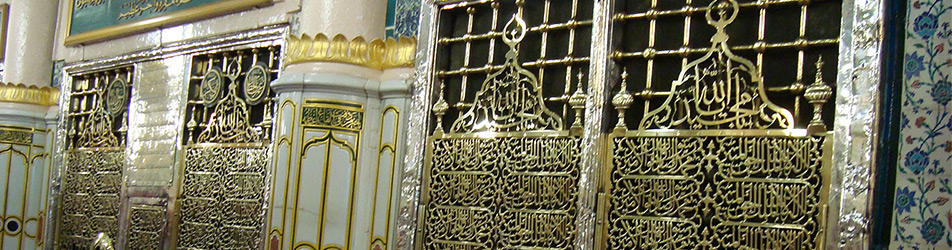
Some senior seekers report that this can be felt by those (having a spiritually ‘alive’ heart) who visit him even today in the radiant city of Medina. (That is, an overwhelming rapture of humility and servitude enters their heart. And Allah knows the best!)

13 Rajab 1429, 16th July 2008.

Real remembrance of death!

baqi102.jpg 

Prior to lecturing at a conference, the great Shaykh al-Hadith MawlanaMuhammad Zakariyah (may Allah ahve mercy on him) was performing ablution (wudhu) when he heard the conference co-ordinator praising him as part of the introduction.The respected Shaykh began to shed tears and said,

My dear ones let me at least die first.

If I die without Iman then what use will all of these praises be to me?

From: In Sahykh’s company

Love, عشق

fire2.jpg

Love is the flame which, when it blazes,

consumes everything other than the Beloved.

The lover weilds the sword of Nothingness

in order to dispatch all but God:

consider what remains after Nothing.

There remains but God: all rest is gone.

Praise to you, O mighty Love, destroyer of all other “gods.”

Rumi، رح

Mathnawi V, 588-590

Humility

makkah_1910.jpg

Shaykh Muhammad ibn Ahmad al-Buzaydi (may Allah have mercy on him) said,

“The humilty of the gnostics (‘arif) keeps increasing until they bring themselves to the level of dogs, and they don’t care. As for him who elevates himself above dogs in terms of physicality, such a person is truly haughty.”

The Adab of Perfect Seeker, page 98.

Imperative characteristics

mecca-plans.jpg

The three imperative characteristics the Shuyukh of Ashrafiya spiritual path (tareeq) try to cultivate in their disciples (murid) are,

1. Absolute following of the Shariah in all situations and under all circumstances

2. Always trying to rectify the lower-self (islah e nafs)

3. A profound conviction that this worldly life is transient and the real and permanent destination is the here-after.

Malfozat e ‘asr e hazera, page 11

Signs of annihilation

allahisakbar3.jpg 

Shaykh Muhammad ibn Ahmad al-Buzaydi (may Allah have mercy on him) said,

“There are three signs that indicate that a person is of those who are annihilated  in the Divine Entity (fani fil-Allah).

First, there is complete shunning of this world. inwardly and outwardly.

Second, there is quietude in humiliation by choice.

Third, there is withstanding of all people’s harm with a good disposition of the soul.”

The Adab of Perfect Seeker, page 88.

Signs of sincerity

Shaykh Dhu-Nun al-Misri (may Allah have mercy on him) said,

“Three things are among the marks of sincerity (ikhlas):

that people’s praises and condemnation be equal to one,

that one is oblivious of one’s works while doing them, and

that one forgets about the reward that one gets for one’s work on Judgement day.”

al-Risala al-Qushayriyya, via The adab of true seeker, page 83-4

Humility: the criteria

Shaykh Abu Yazid (may Allah have mercy on him) was asked,

‘When does an individual acquire true humility?’

He replied, “When being aware of the mischief and bad traits of it he realizes that his lower-self (nafs) does not have any rights at all. And he does not consider anyone else inferior to himself.”

 Awarif al-Ma’arif, page 296

An essential reading for all salikeen from the curriculum of Tasawwuf.

Tasawwuf: Akabir vs us!

Sayyidi wa sanadi Hadhrat Mawlana Mohammad Taqi Usmani (may Allah preserve him) said, 

I t remains unclear what innovations, absurdities and presumptions people have put into the understanding and practice of Tasawwuf. The reality is that going to a friend of Allah (Ahlullah/Shaykh) is to get one’s heart, ego and internal morals rectified.

From Hadhrat (Mawlana Qasim) Nanotwi رحمه الله تعالى till Hadhrat (Mawlana Husain Ahmed) Madni رحمه الله تعالى and Hadhrat (Shabbir Ahmed) Usmani رحمه الله تعالى there was not a single individual (from amongst the scholars of Deoband) who after graduation did not approach a Shaykh (Ahlullah) for his moral reformation (islah).

In our atmosphere these things have become strange. Nowadays if anyone is practicing this (the akabirs’ way), he is said to have become a sufi (in some degrading sense).  The result of this lack of self-reformation (islah) is that the hearts are completely filled with love of worldly/materialistic (dunya) issues, especially love for fame (hubb e jah) and love for wealth (hubb e maal).This is reason that the preacher’s (da’ee) call is ineffective.

In conclusion, a very big reason for the failure of all our struggles and efforts is the abandoning of this concern (fikr) of self-reformation (islah).

[“Islahi Mawaiz: ‘Ilm Par Amal Karen” ]

From: at-Tazkirah (edited to make it easier to understand)

Gift of love

Arif billah Hadhrat Dr Abdul Hayy Arifi (may Allah have mercy on him) instructed the seekers to supplicate the following after each salah,

اللَّهُمَّ أَعِنِّيْ عَلَى ذِكْرِكَ وَشُكْرِكَ وَحُسْنِ عِبَادَتِكَ

(Allahumma a’inni ‘ala dhikrika wa shukrika wa husni ‘ibadatika)

O Allah! Assist me in remembering You, in thanking You, and in worshipping You in the best of manners.

This is gift of love. Presented by the Allah’s beloved to one on his blessed Companions.

One day he (Prophet Muhammad [Allah bless him and grant him peace]) took Mu’adh ibn Jabal (may Allah be pleased with him) by the hand and said, “O Mu’adh, by Allah (exalted is He) I love you, and I advise you, O Mu’adh, never forget to recite, after every prayer (the above).”
[Sahih Ahmad 5:245, Sahih abu Dawud 2:86, an-Nasa’i]

Reality of Tasawwuf: Sunna

The reality of Tasawwuf has been described as,

“Sincerity in turning to Allah, exalted is He, with that which pleases Him and in the way it pleases Him.”

The Adab of the True Seeker, page 22-3

In addition to sincerity, special attention is to be paid to the phrase, “in the way it pleases Him“.  All actions done as per the Prophet’s manner (Sunna) are for sure guaranteed this pleasure. While, none of the innovated ways carry this assurance.

Humility

Our master Shaykh Haji Imdadullah mohajer Makki (may Allah have mercy on him) due to his great humility would say that,

“Those who come to me are definitely better than me. This is because they have one thing for sure; and that is a sincere desire to learn. I on the other hand have nothing as definite as their intention.

From: In Shaykh’s Company