Category Archives: J. Rights

What to ask Shaykh?

Hakim al-Umma Mawlana Ashraf Ali Thanawi (Allah have mercy on him) said,

‘One should keep the Shaykh constantly informed about his spiritual diseases & states and follow whatever he recommends. Just continue with these two things for your whole life.

Inform Shaykh explicitly about your condition. People hide their ailments from the Shaykh. How is it possible that without telling the he will be informed of your condition?

Even if you intend initiating a new worldly endeavor ask the Shaykh would it be detrimental for your spirituality. For example, I intend doing this trade, is it appropriate for me to indulge in it. However, this should not be with the intention that by doing so the trade will be profitable. As though the Shaykh will consult Allah and confirm the success. This should not be the intention at all. This is an extremely corrupt intention.

The method should be like this; I intend to do this business, or I want to be transfered to such a position or I want to study English or medicine would it be detrimental for my spirituality.

These are the things to be asked from the Shaykh.

Nowadays people do whatever they desire. They do not inform the Shaykh. Hence, they corrupt their spirituality. They make excuse that these are worldly issue and it is not essential to inform the Shaykh about them. Whereas in reality these things have major effect on one’s spirituality.

Therefore, whenever you intend to initiate a new worldly endeavor inform the Shaykh in advance and get his advice regrading it.’

Waaz Rahat al-Quloob, page 263-4

Whom to follow?

_____________________

Imam al-Ghazali and the signs of the ‘Ulama

____________________

A considerable confusion exists among the Muslims regarding the religious leadership.

This is compounded by the plethora of religious information and instructors online.

Some people endorse scholars from a particular lineage, others from a particular ethnicity, fiqh following or no fiqh following and others look up to some families that their forefathers have been following  from centuries. Many recommend any scholar with a continuous teacher-student lineage (sanad) reaching up to our master Prophet Muhammad (Allah bless him and grant him peace.)

However, the confusion remains.

The most beneficial information in this regards is the one being presented in the above article. It expounds on the qualities a true scholar must have.

Shaykh al-Hadith Mawlana Zakariyyah (Allah have mercy on him) quoted this in Fazail -e-Sadaqat, from ‘Proof-of-Islam’ Imam Ghazali’s (Allah have mercy on him) epic work Ihya al-Uloom ad-Deen, volume 1.

Realizing its benefit Mawlana Mazoor Nomani (Allah have mercy on him) published it in a seprate booklet (Ulama-e-Akhirat ki pehchan, (Urdu) Al-Furqan book depot,Nazeerabad, Lucknow).

It is fortunate that Mawlana Ismael Nakhuda khalifa of Shaykh Mawlana Abdul Hafeez Makki (Allah preserve them) translated and edited this for the benefit of English speaking masses. Allah reward him abundantly. Amin!

Following is a brief summary of the qualities. Careful and repeated readings of the full article in highly recommended to understand and apply this important information in our daily practical life.

1.  An ‘alim is one who does not try to acquire wealth through his learning.

2.  A true ‘alim is that there should be no contradiction between his knowledge and his practice of din.

3.  He is always concerned with such branches of knowledge that are beneficial for the hereafter and which exhort one to perform good deeds.

4.  He is least interested in the elegance of dress or delicacies of food.

5.  He (without any necessity) keeps away from sultans and rulers, and never visits them.

6.  He does not take hasty decisions when giving verdicts in religious law (fatwas) and is very careful in giving advice on religious matters.

7.  He is seriously interested in the esoteric science, in other words Suluk.

8.  His faith and belief in Allah Most High is ever increasing and they are always concerned about this — firm belief is [a believer’s] capital.

9.  Under all conditions, he should wear a true expression of being inspired with the fear of Allah Most High.

10. He is more concerned about those regulations of Islamic law which pertain to religious practices; to what is lawful and unlawful.

11.  He has studied, with deep insight, various branches of knowledge. He does not accept the opinions of others, for we are bound to follow the Messenger of Allah (may Allah bless him and grant him peace) and seek guidance from his sayings alone

12. He is strict and stringent in his avoidance of bid’ah (innovations).

Continue reading……………………..

Cancellation of khilafet

__________________________________


Mawlana Shah Wasiullah Allahabadi (Allah have mercy on him) wrote the following to one of his deputies (khalifa),

‘You are aware of the vigilance in maintaining appropriate morals (ikhlaq) in my training. In spite of this what did you do? Mawlana XYZ (a very close murid and another khalifa) came to your town. Considering you to be a close friend (pir-bhai) he paid visit to you. However, you dealt with him coldly showing extreme indifference. Moreover you scolded him.

This (attitude) reveals that you are not capable of instructing and guiding others. Therefore, I cancel your permission (ijazat).

I inform you that should not instruct or guide anyone on my behalf. Neither should you correspond with me nor bother to visit me. Inform all other people (in your area) about this.’

Halaat e Muslih al Ummat, volume 2, page 104

———————————-

Absurd Hajj

____________________

________________________

A close murid residing in Saudi Arabia was coaxed to perform (nafil) Hajj by some friends without the permit (tasrih: the locals are allowed to perform Hajj every 5 years, provided they make arrangements with an agent and pay him for transportation, lodging, etc). Moreover, he did what the locals commonly do. They intentionally leave most of the Sunna, just focusing on the essentials (wajibat) and do whatever is most convenient to themselves. That is, no staying overnight in Mina, performing rami-e-jamarat after sunset, squatting on footpaths and roads for the time they are in Mina,  hire small buses for transportation that increase traffic congestion, pitch their own tents or stay in others tent without rental payment, etc.

Sayyidi wa sanadi Shaykh Mawlana Mohammad Taqi Usmani (Allah preserve him) was obviously upset to know these details. He reprimanded the individual firmly and commented that’

‘This was an absurd (bay-tuka) Hajj.’

Alhudmdulillah, the tarbiyet worked. 

The murid realized and acknowledged his mistakes. He asked forgiveness from Allah and made a firm decision not to repeat these mistakes. These included,

– disregard for the law set by government.  (Permit is to ensure accountability,  establish arrangements, ease overcrowding and plan for the future.)

– causing problem to other guest of Allah, who paid for their arrangements

– leaving Sunna intentionally, an explicitly sinful action

– acting on emotional desires and enthusiasm, in place of following the Shariah ruling

-acting against the Shaykh’s established viewpoint (sayyidi wa sanadiMufti Taqi Usmani sahib (Allah preserve him) strongly approves the permit system and encourages all to stick to it.

In short the virtuous actions, even a Hajj, has to been done in an proper manner for it to be accepted by Allah and be beneficial in our islah.

This requires tarbiyet (training under supervision).

wa ma tawfiqi illa billah! 

 ______________

Ummah of Prophet Muhammad

Arif billah Dr. Abdul Hayy Arifi (Allah have mercy on him) said,

‘You are from the Ummah of Allah’s beloved Prophet Muhammad (Allah bless him and give him peace). 

So, what rights of his   love and respect are you fulfilling?

How much is the desire and enthusiasm in your heart to follow him  ?

Do you follow his Sunna in your appearance, clothing, daily living and dealings?’

Ahmeyet e ramadhan, page 33

Topic of islahi talks?

A senior associate of Shaykh Wasiullah Allahabadi (Allah have mercy on them) descibing the Shaykhs methodolgy in this regards said,

 ‘The Shaykh did a thorough study of the state of the common and elite (around him). Then according to it he started to advice them in the light of Quran and Sunna. The success of this method is clearly evident in all the sectors of population (that visited him).

It was not that the people required instructions in the basics and in front of them the superior states of the Holy Companions (Allah be pleased with them) were elaborated and no discussion was made about the spiritual diseases afflicting the audience. This would have confused them about their own spiritual state. (That is, by being ignorant of their own poor diseased state and falsely comapring it to the  (healthy) believers state.) Then for obvious reasons how could they strive for islah ?’

Halaat e Muslih al-Ummat ra, volume 2, page 38-9

Tarbiyet

Shaykh Mawlana Shah Wasiullah Allahabadi (Allah have mercy on him) often used to cross-examine and challenge the spiritual aspirant by asking questions and making comments. This was for their tarbiyet. That is, inculcating deep in their mind a clear objective of the spiritual path and necessity to work sincerely and diligently for it. 

Some of these included,

‘Why do you people come here?

You have been staying here with me for so long what changes have you brought in your practical life?

What was discussed in the majlis today and what effect did it have on you? Every individual should write it down and give it to me.

You do not have yearning or reverence or respect of the Shaykh?

You do not have sincerity. In its place you have hypocrisy, diplomacy, manipulation, pretense and preference for the worldly. Therefore, your islah is difficult. You should go somewhere else. Why do you corrupt our place?

You have deficency of love or fear of Allah or regard for the Shariah’s grand status.

You display quiescence for the daily routine, a care-free and reluctant attitude, and heedlessness. Therefore, you should stay at your home and disseminate the effects of these things there. Why do you come here to do this?’

Halaat e Muslih al-Ummat ra, volume 2, page 17-8

Components of islah

Shaykh Wasiullah Allahabadi (Allah have mercy on him) said,

For islah (spiritual improvement, reformation, betterment) two things are essential.

One of them is instructions (ta’leem) and the other is training (tarbiyet).

The instructions are what you people do by this learning from books (lectures, etc.) from me. However, only instructions are not sufficient (for islah). They must be accompanied with training and spiritual cleansing (tazkia). It is for this that I bother you people and ask questions, admonish and catechize. This is the tazkia and tarbiyet’ (to acertain practical application of instructions given for successful achievement of islah).

Halaat e Muslih al-Ummat ra, volume 2, page 23 

Visiting other Shuyukh

Hakim al-Umma Mawlana Ashraf Ali Thanawi (Allah have mercy on him) said,

‘Previously it was my habit that where ever I went I visited the scholars and Shuyuk of that locality. This was irrespective of their spiritual demeanor(mashrub) . However, now after experience I do not do this any more. Moreover I advise my friends that doing this is dangerous. In the past people had goodness in their character now they have mischief. Nowadays instead of benefit harm is possible. Those who (continue) do so I find them to be confused most of the time. I receive many letters stating that since I visited so and so the state of my heart’s corruption is this.

A novice (mubtadi) should not meet different Shuyukh because it causes turbulence (in thoughts) and destroys the spiritual serenity (yuksui). Whereas, in this path (sulook) it is essential to maintain spiritual serenity and fortitude (jamiat e qalb). If they are destroyed (by visiting different Shuyukh), then of what benefit is this in the first place?’

Halaat e Muslih al-Ummat ra, volume 2, page 7-8

Regarding Tablighi Jamat

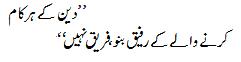
الدین النصیحہ

Instructions of Muslih al-Umma Shaykh Wasiullah (Allah have mercy on him) in particular to his associates and admirers and in general to all Muslims.

I have received information from various places and reliable sources that in some localities people are meddling with the Tablighi jamat. They neither perform  a work of deen themselves nor they allow others to do so by creating many obstacles in their task. I consider it to be a extremely bad thing that an individual neither does a work himself nor  he allows others to do so and in addition he makes so many objections on them that they are troubled and abandon the task itself.

The need of religious effort in this era is quite evident. It is vividly obvious that many people are required to do this task. It is well known that in every era there will be some servants of Allah who will serve the religion ardently and safeguard it with their soul and life. It is possible that there may be various different ways to fulfill this single purpose. Hence, in this era the truthful scholars (may Allah reward their effort) are doing this struggle to the best of their abilities.

Even if someone disagrees with a particular methodology the best thing to do is to continue working according to his own method to the best of his ability. However, he must also encourage, help and supplicate for the others working for the religion. If he comes to know about some of their lapses then wishing them well he should advise them politely.  He should neither abuse the Jamat itself nor blame their elders due to the slips of few individuals or lay people. I detest this extremely and consider it to be a source of fragmentation among Muslims.  This is not the time for such things. It is essential to make effort to create mutual love and friendship among Muslims and get rid of envy and enmity form their hearts. Mutual co-operation and unity are the stepping stone for any effective religious or secular endeavor.

It is for these reasons I instruct in general to all Muslims in particular to my associates and admirers that the should not meddle with any group  that is doing religious work (including the Tablighi jamat and others). Instead they should help and assist them. If they can not do so then they should at least supplicate for (Divine) good for them. This is because respected Mawlana Mohammad Ilyas (Allah have mercy on him) is from our elders. God-forbid, he is not an innovator or insincere individual, that his group be rejected and criticized.

As far as the issue of mistakes in the method of the newer generation is concerned it has come to my knowledge that the scholars and superiors of Jamat are aware of these. They are not negligent about these and will make effort on their own to make reformations. It should be none of of our concern to meddle with the effort of deen already taking place and unnecessarily open a new gate of calamity (fitnah) among Muslims.

In these perilous times I consider most minute of the  calamities (fitnah) to be fatal for Muslims. Therefore, I want to remain aloof from them and recommend my admires to do so. This is because the religion is to offer (beneficial) recommendation.

Halaat e Muslih al-Ummat ra,page, volume1, 376-7

——————–

Reason for not benefitting from khanqah!

An individual commented,

‘We have seen people who did not reform (islah) their lower self (nafs) staying in khanqah, however, those working in (Tablighi) jamat achieved this.’

Mawlana Abdur Rehman Jami khalifa mujaz e sohbet of Shaykh Wasiullah Allahbadi (Allah have mercy on them) replied,

‘The reasons why the reformation of an individual who stays in khanqah does not occur are;

 Either, that specific khanqah is not a reformative khanqah (to begin with)

Or the that individual is involved in practicing hypocrisy (nifaq e amli). He deceives the Shaykh and progresses only in his hypocrisy.’

Halaat e Muslih al-Ummat ra, page 370

Hypocrisy: a pretense of having a virtuous character, moral or religious beliefs or principles, etc., that one does not really possess.

Hypocrisy is the opposite of sincerity (ikhlas).

Request for dua

______________

أَذْهِبِ الْبَأْسَ رَبَّ النَّاسِ وَاشْفِ أَنْتَ الشَّافِي لَا شِفَاءَ إِلَّا شِفَاؤُكَ شِفَاءٌ لَا يُغَادِرُ سَقَمَاً

Please, make dua (supplications) for the health of sayyidi wa sanadi Mufti Mohammad Taqi Usmani (Allah preserve him).

JazakAllah.

____________

حضرت شیخ مدظلہ

_________

_____________

مرجع ارباب ھدایت، مركز دائرہ ولایت، مقتداے اصحاب شریعت، پیشواے ارباب طریقت

دلیل سبیل فلاح و رشاد، رھنماے طریق استقامت سداد

ھادی زمانہ، مرشد یگانہ،، غوث زماں، قطب دوراں

سراج المحبین، تاج المحبوبین، زبدة العارفین، عمدة الصلحاٗ و كاملین

عالم علوم ربانی، ماھر اسرار قرآنی، قدوة اصفیا، اشرف اولیاٗ

آیة من آیات اللہ، حضرت مولانا ‘مفتی الشاہ محمد تقی عثمانی’ صاحب

لازالت شموس فیوضھم بازغة و بدر مكارمہ طالعة

متعانا اللہ و جمیع المسلمین بطول حیاتہ و بقائہ

و نفعنا و سائر الطالبین باقوالہ و افعالہ

آمین

__________

حالات مصلح الامت رح، ص ٢٣٨، ‘’ تبدیل شدہ

__________