The four worst sins in Shariah


Hujjat al-Islam Imam Ghazali (Allah have mercy on him)  has mentioned following to be the worst sins in Shariah:

1. Associating partners with Allah SWT. Either in His being or His attributes.
2. Considering a sinful act to be within the acceptable limits in Shariah. That is, to consider it halal.
3. Because of failure in one’s efforts, give up performance of  good actions (yaas).
4. Because of being unafraid of Allah SWT, commit the prohibited actions without any reservation (nedar).

We all must ponder over the second crime (in bold).
How many sins prevail in our daily life and how lightly do we take them?

Sayyidi wa sanadi Moulana Mohammad Taqi Usmani sahib (Allah preserve him) tells us to leave all the sins immediately. However, due to our weak determination, non-Islamic surroundings or secular social pressures if we are not able to do so, we should make a habit of repenting for these sins every night, each single day. This will at least keep our balance sheet of deeds clear. And if God forbid, we were to die, there won’t be the huge amount of sins in arrears for punishment waiting.

توبہ میری جام شکن، جام میرا توبہ شکن
سامنے ڈھیر ہے ٹوٹے ہوۓ پیمانوں کا

Pious Companionship (esp. for the Youth)

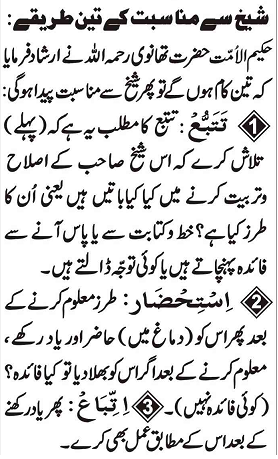
Hakim al-Ummat Mujaddid Shaykh Mawlana Shah Ashraf Ali Thanawi (Allah have mercy on him) said:

The vital component for reformation (islah) is (companionship) suhba (of the pious), even without formal knowledge. Moreover knowledge without pious companionship (suhba) is useless. An uneducated person who keeps pious company reforms more successfully as compared to knowledgeable person without good company.

It is for this reason I tell that the children attending secular schools should be sent to visit the pious knowledgeable men (awliya). And if their elders also take note of this it will be very beneficial for all.

And I promise that neither will we rebuke them regarding their trousers being below ankles nor discuss the issue of their beard (being absent or being less than a fistful) and nor will we coerce them to pray (salah).

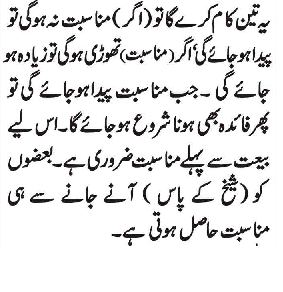
They will sit with us and in the result we will develop a mutual likability and friendliness and they will also develop a congeniality (munasbet) with deen. And this munasbet is the root cause and source of all (necessary) knowledge and actions.

Not all the Sahaba ra (The Holy Companions) were knowledgeable scholars, they benefited via companionship (suhbet) only. And for these reasons Awliya have always emphasized more on being steadfast with pious companionship as compared to acquiring knowledge.

Malfoozat Kamalat-e-Ashrafiya 172

With the summer vacations here, please, consider sparing few weeks, days or even hours from our busy schedule to be in the company of the pious . This will be an investment for us and our children.

May Allah give us the tawfeeq and facilitate its happening.
Ameen, bi-jah-e-Sayyid al-Mursaleen

How to deal with a difficulty?


Arif-billah Dr. Abdul-Hayy ‘Arifi (Allah have mercy on him) said:

When faced with a difficulty which seems to be either unavoidable or irresolvable, our Hadhrat (Hakim al-Umma) used to advice us not to think and ruminate about it. Start making dua in your heart regarding it. And repeatedly recite اياك نعبد و اياك نستعين.

By doing so, inshaAllah, the anxiety will vanish, peacefulness will be achieved and the difficult task will be settled with ease.”

Ma’moolat-e-yoomia 25-6

Become a Human first!

==========

Hakim al-Umma Mawlana Ashraf Ali Thanawi (Allah have mercy on him) repeatedly told people who approached him for reformation (islah):

“If you want to become a saint, a qutub or an abdal go elsewhere. Stay here only if you want to become a human being.”

Lacking the basic qualities of a human being an individual can never even be a true Muslim.

Love, sympathy, wishing well, being honest, sincere, polite and well mannered when dealing with others (even non-Muslims) are the basic rights of all human beings.

How can one gain Allah SWT’s pleasure, (that is being a devout sufi) when he/she is destroying these rights?

Hujjatul Islam Imam Ghazali ra has categorized living creatures in three types:
1. Those, which are always harmful. For example snakes, scorpion, lizards, etc.
2. Those, which are always beneficial. Like sheep, cows, horse, poultry etc.
3. And finally those, that are neither harmful nor beneficial. Like parrots, peacocks, zebra, etc.

Then he poses a question to us: in which category do we fit?

Cynical, acrid, humiliating and arrogant comments that hurt another’s feeling surely without any doubt make us similar to scorpions and snakes!

ع– درد دل کے واسطے پیدا کیا انسان کو

Email: Please, ponder for a moment

__________

www.ashrafiya.com

____________________

A respected reader sent me this email today.

‘Today I was coming towards Tower from Liyari express way. There was a car (written www.ashrafiya.com on rear glass window) in front of my car. It stopped on the intersection (a very dangerous place to stop a car) where a couple of ba reesh people get off loaded and another (non ba reesh) got out of back seat and went to sit in front. It sounds that it does not take any time but,

1. Is not it a sin to stop a car where it is against rules of traffic and create problem for human beings? (huqooqul ibad ka koi darja/ignoring the rights of other-fellow human beings!)

2. When I honked, the (non ba reesh) showed me his anger that lead to further gali galoch as a result of road rage.(apni ghalti pay nadim honay k bajai badtamizi/being insolent, not acknowledging his mistake or having any remorse..)

If the ba reesh driver and his two companions have no sense of huqooq ul ibad and no sense of traffic rules then they must not place ‘www.ashrafiya.com-sticker’ on their cars so that the do not bring disgrace to it.

I think there is a serious requirement that these petty things should be discussed in coming lectures where importance of traffic signals, speed limits, zebra crossing and other things should be taught as not following such rules and creating problems and hassles for fellow human beings is a sin. Kia pata meezan may yahi bhari par jai.

Allah ham sab ki maghfirat farmai
(ameen)’

JazakAllah!

Repentance & Sins: Repent again

Sayyidi wa sanadi Mawlana Mufti Mohammad Taqi Usmani (Allah preserve him and allow us to benefit from him abundantly. Ameen!) said:

“Hold fast to this advice.

That is, do not be disappointed and become disheartened by the repeated failures of repentance by committing sin.

Confront this failure of repentance by making a solemn determination (never to commit that sin again).

If you fail again, renew your determination again.

This mental struggle and physical effort has to continue until the end of life. Do not be discouraged by the repeated failures in keeping up with repentance. Hence, deciding not to repent. This depressed attitude is not correct.

Repent with a more solid determination (never ever to commit that sin again).”

Islahi majalis, volume 5, page 245

باز آ باز آ ہر آنچہ ہستی باز آ

گر کافر و گبر و بت پرستی باز آ

ایں درگاہ ما درگہ نوامیدی نسیت

صد بار گر توبہ شکستی باز آ

Seeking repentance


Shaykh Mufti Muhammad Rafi` Usmani (may Allah preserve him) states:

In the Noble Qur’an, the command for repentance has been given as such:
تُوبُوا إِلَى  اللَّهِ جَمِيعًا أَيُّهَ الْمُؤْمِنُونَ لَعَلَّكُمْ تُفْلِحُونَ 

Turn to Allah in repentance, all of you, O believers, that you might succeed. (Surah Nur, Verse 31)

Each one of us is involved in some sin or another, as no one is free from sins. Some of us, however, commit more sins and some of us less. From all people, though, the best are those who repent. Therefore, when a sin is committed, keep the requirements of repentance in mind and immediately repent.

In Surah Tahrim, Allah Most High says:

يَا أَيُّهَا الَّذِينَ  آمَنُوا تُوبُوا إِلَى اللَّهِ  تَوْبَةً نَّصُوحًا

O you who believe, repent to Allah with a sincere and firm repentance (Surah Tahrim, Verse 8

This verse refers to a repentance that is both sincere and has firmness. Therefore, we can see that, despite being innocent and protected from sin, the Holy Prophet (Allah bless him and grant him peace) used to seek forgiveness from Allah more than 70 times in a day (as mentioned in a Hadith.)

Now, the question comes to mind: If the Holy Prophet (Allah bless him and grant him peace) did not sin, then from what did he repent? Understand that there are two aspects to this:

One purpose was to set an example for the Ummah. If the most beloved creation to Allah and such an exalted messenger used to seek Allah’s forgiveness more than 70 times a day, then we should do even more than that.

The Holy Prophet (Allah bless him and grant him peace) did not seek forgiveness due to sins. His good deeds and piety are matchless. However, it has been set that the Holy Prophet (Allah bless him and grant him peace) would, in his supplications, frequently say statements meaning: “O Allah! We have not fulfilled the right of Your worship, as its right is. We have not recognized You as Your right is. We have not  acquired the piety as Your right deserves. We ask forgiveness for our shortcomings in fulfilling Your rights.”
 
In another Hadith, it is mentioned, “O people! Repent to Allah and seek his forgiveness. Verily, I repent 100 times in a day” (Muslim).

In the previously mentioned Hadith, the count was not specified, but in this Hadith, it is specified to be 100. Therefore, when our elders instruct people on adkhar, tasbihaat, and ma’mulaat, they always include 100 times istighfar (seeking forgiveness) with the following words:  

استغفر الله ربي من كل ذنب وأتوب إليه

The word tawba (seeking repentance) is also included here; however, it is also important that we also make the intention for seeking repentance.

So if the Holy Prophet (Allah bless him and grant him peace) used to seek Allah’s forgiveness 100 times in a day, and this is also included in the routine of our elders, then we should also bring this deed into practice.”

Tawba ki Haqeeqat Aur Ahmiyat

(Translated by brother I Khan)
What is Tasawwuf?

Following is a summary of a talk by ‘Arif-billah Dr Abdul Hayy ‘Arifi (Allah have mercy on him) ,

Keep your understanding of Tasawwuf clear.

Do not be misled by those who consider it to be limited to the recitation of litanies and excessive remembrance (dhikr).

Practical application of Tasawwuf in everyday life boils down to paying close attention to the rights of the others. Make sure that you do not become a source of any discomfort for them, however, minute it may be.

And remember, the most immediate, important and best evaluation of your  success in this endeavor will be your dealings, attitude and behavior with your spouse .

(Audio waaz)