Category Archives: N. Advice

Seeing the useless

20130110-194503.jpg

Shaikh Abdul Ghani Tarablusi al Khalwati (Allah have mercy on him) said,

‘It is from the etiquette (adab) of a murid to be cautious in observing and speaking about the useless issues.

The significance of this may be understood clearly with this incident report. A Shaikh dismissed one of his murid when he came to know that he had destroyed a wine keg he saw in the marketplace. Explaining this dismissal the Shaikh said that the reason was not his action to prevent a vile thing (nahi anil munkar) but his careless use of sight in observing the useless. This would have never occurred if his sight was at his feet (as is recommended, to abstain from seeing useless).’

Tarsih al Jawahir al Makkiyah fi Tazkiya tul Aklaq al mardhiyah, (Urdu), page 125

Similarly, a seeker while in the sacred masjid al Haram Makkah commented on the extravagant use of electric lights, especially to illuminate the minarets, etc.

Shaikh Dr Hafeezullah (Allah have mercy on him) replied,

‘Observing these sorts of things is superfluous and inappropriate use of sight.’

All of us, who aspire to be spiritual seekers, must take a moment and reflect on this.
Furthermore we should ponder, this is in regards to observing the useless. How severe the consequences would be on seeing the sinful things?

Taqwa and remembrance of Allah

20130105-205707.jpg

Shaikh Abdul Ghani Tarablusi al Khalwati (Allah have mercy on him) said,

‘It is imperative to ward off Shaytan from one’s heart (qalb) with simultaneous use of weapons of determined awareness of Allah (taqwa) and His remembrance (dhikr).

It must be clear that remembrance alone without taqwa is not effective at all in this effort.’

Tarsih al Jawahir al Makkiyah fi Tazkiya tul Aklaq al mardhiyah, (Urdu), page 00

Remembrance of Allah

20130102-215834.jpg

A spiritual seeker wrote,

‘My heart now desires that no moment should pass without the remembrance of Allah. After the governmental office work and while traveling on the road I continue to recite something like istegfar or the blessed durood without keeping a count. However, once at home with children this preoccupation is lost.

Hakim al Umma Mawlana Ashraf Ali Thanawi (Allah have mercy on him) replied,

‘If at that time you maintain this thought that these are a blessings bestowed by Allah then this activity will be included in the remembrance and contemplation (of Allah).’

Tarbiyet us Salik, volume 3, page 139-40

Who is a sufi?

qul rabbi zidni ilma

Shaikh Abdul Ghani Tarablusi al Khalwati (Allah have mercy on him) writes in the initial instruction for a seeker,

‘There are various categories of good deeds. They include the essentials (faraidh), the highly recommended (wajib), Sunna and desirable (mustahib). It is a must for the seeker to start with what is most important. That is, to follow the hierarchy of these actions.

The one who does not follow this hierarchy is ignorant and misguided.

For example, if an individual has fardh salah that has to be expiated and instead of doing that he is involved in offering supererogatory (nafil) salah. Similarly, an individual has to pay back his loan or fardh zakah but he is donating in supererogatory charity. Also, an individual’s parents are in need of his service but he abandons them for a desirable (mustahib) action. All of these are examples of misguided and sinful activities. They darken the heart (qalb).

However, following this hierarchy of deeds is not possible effectively without the guidance of a qualified (kamil) Shaikh or acquisition of knowledge of Shariah laws (fiqh).

It is for this reasons it is said ‘a sufi is a scholar who acts on his knowledge’.

Tarsih al Jawahir al Makkiyah fi Tazkiya tul Aklaq al mardhiyah, (Urdu), page 98-9


Treatment of extreme grief

makkah15

A mureed wrote to Hazrat Hakeemul Ummat Mawlana Ashraf Ali Thanawi ra,

“My mawlana and murshid, as salam o ‘alik,

A great misfortune has struck me now. My heart can not bear its severity. My beloved son, who was 19 years old, died being afflicted with cholera. He had completed high school by virtue of his own capabilities. Now was the time for him to flourish and progress further. He was my only son, so with his death my share in the future of this world ended.

انا للہ واناالیہ راجعون

زمیں چمن گل کھلاتی ہے کیا کیا

بدلتا ہےرنگ آسمان کیسے کیسے

Please, for the sake of Allah SWT, make dua regarding patience for me. I am about to have extreme despair. Tell me something to recite (if it may be beneficial in gaining patience).

Hazrat Hakeemul Ummat Mawlana Ashraf Ali Thanawi ra replied:

Epitome of good morals and gentleness, may your calmness prevail,

as salam o alaikum wa rehmatullah,

I was aggrieved by passing away of your son. Allah SWT make his magfirah and give you saber e jameel (outstanding patience).

You should read the chapter of patience in (Imam Ghazali ra’s) Kemiya e Sa’adet repeatedly.

Recite لا حول و لا قوۃ الا باللہ excessively all the time.

Keep excessively the image of the living person with whom you have excessive ‘aqidet (reverence) in your thoughts.*

InshaAllah, with these measures tranquility will be achieved. I am also making dua for the best for you.

However, since you have a relationship with me for the betterment of your religious state and this can not withstand any formalities, it is essential to mention with all sincerity that I was aggrieved more by the reasons of your grief than the actual incident of his passing away. You overstepped the natural grief by mentioning the intellectual reasons for it, such as, he had completed high school, now was the time for him to flourish and progress, my share in this world ended.

This means that the major grief is on loss of these worldly pleasures. All of this concludes that one’s primary goal and objective is this dunya (world).

Utterance of such things from mouth or pen of seeker of truth is like proclamation of shirk (associating partners with Allah SWT) from a monotheist.

This is a bigger calamity than the other tragedy. That is, why one’s qalb (heart) is like this, with such desire? This definitely needs amendment.

Jamadi aula, 1322 H

At-Takashuf an muhimatit tasawwuf, page 22-3/Tarbiyatus Salik,

*This is most probably to distract the afflicted from being engrossed in imagination of the deceased, resulting in more sorrow. Allah SWT knows best!

The Divine prescription for loss

20121226-100417.jpg

Shaikh Mansur Ali Khan (Allah preserve him) said.

Once I was in the company of Arif billah Dr Abdul Hayy Arifi (Allah have mercy on him). There was no one else. Hazrat Dr Arifi read aloud a letter send to him for spiritual advice.

It was from a young girl. She had been on vacation with her father in the northern areas of Pakistan. One day while traveling by bus it was fajar time and his father requested the bus driver to stop for salah. He agreed. Her father while disembarking the bus was run over by the speeding car coming from behind. The family rushed to help him. However, he was badly injured and died in front of them. They were devastated.

The daughter was now requesting for dua and words of consolation.

Dr Arifi looked at me and asked,
What should I write her?

I had no clue at all.

Dr Arifi closed his eyes and contemplated for few seconds. Then he said,

أنا لله و أنا اليه راجعون

Recitation of this is the soothing treatment for a bereaved heart. It is prescribed by Allah and established by practice of our master Prophet Mohammad (blessings and peace of Allah be upon him).

Recite this repeatedly in abundance.’

Turning to this lowly writer Shaikh Mansur said,
‘Please, convey this to your brother. I am making dua that Allah makes magfirah of his son and give sabr e jameel to the parents.’

Amin!

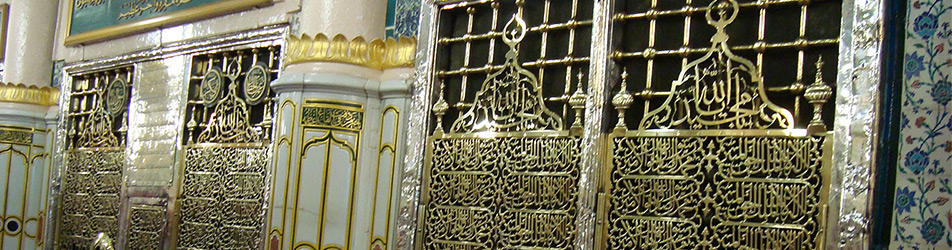
Masjid Nabawawi (ala sahibeha alf alf salawat o Salam) close to extreme right front corner of the original masjid.
After fajar 26/12/2012CE 13/2/1434H

Dangers of excessive grief

20121222-191359.jpg

Shaikh Mohammad Kaleem (Allah preserve him) a senior khalifa of Arif billah Dr Abdul Hayy Arifi (Allah have mercy on him) said to a brother who lost his twenty three year old son suddenly,

‘Excessive intentional discussion of the deceased is to be avoided. This is because of the remote possibility of development of a thought questioning the Divine decree. That is, why did this happen?

This will be against the patience required.

Therefore, be careful.

Every time his discussion comes up recite,
أنا لله و أنا اليه راجعون
contemplating the meanings discussed earlier.’

Shaikh Mohammad Kaleem sahib db’s residence. Darul Uloom Karachi, Sunday, noon, 18th December 2012.

Real patience:safety from grief

20121219-231330.jpg

Shaikh Mohammad Kaleem (Allah preserve him) a senior khalifa of Arif billah Dr Abdul Hayy Arifi (Allah have mercy on him) said to a brother who lost his twenty three year old son suddenly,

‘It is only in Islamic teaching that we find a definite contentment from grief and loss. It is very effective and well tested.

At the times of grief and loss we recite

أنا لله و أنا اليه راجعون

“We certainly belong to Allah, and to Him we are bound to return.” (2:156)
However, it is a pity that we do it without contemplating on its meaning.
In fact the reality revealed in this verses is so immense that contemplating on its meaning will remove all grief. In it Allah conveys , that in relationships this (lost one) maybe your mother, wife, father or son, etc., however, all these relationships are temporal (majazi) and temporary. They have been created for effective functioning of the society in this world. Whereas, in this verse Allah makes it explicitly clear that nothing in this universe belongs to anyone. It all belongs to Allah alone.
Why is it so?
It is because Allah is the creator. They are all created. He created them from nothing. He is their sustainer. They all belong to Him. They can not comprehend the rationality behind His commands and magnanimity of His decrees. They have been instructed with these temporal relationships of being a father, mother, wife, etc. In reality they all belong to Allah and He alone owns them. Hence,
He has full right to deal in their affairs as He desires. No one can question or forbid Him.
Moreover, it is His mercy that He has informed us in advance that we are going to be afflicted with grief and loss either in financial issues or in status or with death of a dear one. And in these circumstance if we observe the patience that is required, that is, the proclamation of His Divinity and acknowledgement that every thing belongs to Him alone, then we will be rewarded with a compensation that is beyond our imagination. Moreover, we will receive His special mercy, salutations and be from the perfectly guided individuals. An immense reward indeed for patience.
How can a person grieve when he acknowledges that everything belongs to Allah alone, He has full right to do whatsoever and He does so with absolute wisdom.’
Shaikh Mohammad Kaleem sahib db’s residence. Darul Uloom Karachi, Sunday, noon, 18th December 2012.


Way to islah

Hakim al-Ummah Mawlana Ashraf Ali Thanawi (Allah have mercy on him) instructed,

‘Pray two rakah salah with intention of making repentance and then supplicate as follows;

O Allah! I am Your obstinate disobedient servant.

I want to become obedient but nothing happens with my desires. However, everything is possible only with You.

I want to reform myself but I lack the determination to do so. Only You can reform me.

O Allah! I am extremely inapt, severely corrupt and very sinful. I am failing. Please, help me!

I have a weak determination to resist temptations of sinful activities. Please, give me the power to do so.

I do not have anything for salvation. Please, provide me with the means of salvation from Your hidden treasures.’

For ten or twelve minutes  make repentance arduously. Then say;

‘O Allah! Kindly forgive all the sins that I have committed till now. Though I do not say that I will not commit them again. I am aware that I will do them again. However, I will ask for forgiveness again.’

In this manner daily ask for forgiveness, acknowledge your weakness, supplicate for betterment (islah) and verbally recount your ineptness, corruption and evilness. In short, debase yourself explicitly in front of Allah daily for ten minutes.

O brothers! Neither take the medicine nor abstain from the harmful, only use small quantity of this elixir daily prior to sleep.

In few days you will observe that from Divine sources your determination will become strong without facing humility and hardships. Overall, things will happen from Divine which you can not even imagine now.’

Waaz: Milat e Ibrahim, Volume 31, page 390, quoted from Majalis e Hazrat Eshrat ra, page 13-4


Our purpose

Shaikh Khawaja Mohammad Ma’soom (Allah have mercy on him) wrote,

‘The purpose of traversing the path (sulook) is not to become a Shaikh and take murids.

The goal is to fulfill the duties of being a slave of Allah without the involvement and resistance of the lower self (nafs).

Moreover, the purpose of this path is to achieve anonymity and ward off rebelliousness of the nafs and being self opinionated. This because the  acquisition of Gnosis (marifa) is dependent on these things.’

Maktoob, quoted via Tofah-tush-Shuyuk, page 49

Islahi relationship

Shaikh Mawlana Abdul Hafiz khalifa of Shah Abdul Ghani Phulpuri (Allah have mercy on them) said,

‘Many people develop an islahi (self betterment & improvement) relationship (with a Shaikh). However, few of them fulfill its rights.

The right of this relationship is to consult the Shaikh in every issue and follow his recommendations. There are very few individuals that follow the recommendations (thoroughly). One has to stay away from self opinion (khud-raiy) and self conceit (khud-beini). Otherwise, instead of proximity and pleasure (of Allah) one is distanced (further away) from Him.

This is a very clear but subtle path.

Only the individual who follows the recommendations thoroughly will progress on this path.’

Malfuzaat e Hafiziya, (pdf online) page 50-1


Instruction and own islah

The reviver of Islam Shaikh Ahmad Sirhindi (Allah have mercy on him) wrote to one of his deputies (khalifa),

‘Be concerned about your own affairs (that is, your relationship with Allah), so that you leaves this world safely (with eman).

In the hereafter certificate of authorization (ijazet-nama) or (increased number of) disciples will be of no help.

Indeed! While managing your own affairs if anyone comes (asking for guidance explicitly) with sincere yearning then instruct him about the path. However, do not make the instruction about the path (tariqat) your main goal and management of your own affairs subservient to this. Doing so will be an affliction and loss for you.’

Maktoob 228, quoted via Tofah-tush-Shuyuk, page 48

Controlling sight and tongue

Shaikh Haji Shakeel Ahmad (Allah preserve him) said,

‘Be totally silent. Develop this habit (of keeping the heart attentive towards Allah), especially here in illuminated Medinah. Remain mute, deaf and blind here. Keep your sight focused to ground. Do not look at anything except for the essential, like way towards the door of blessed mosque.

The sight and speech should not be used without an active intention. If this control is achieved one is bestowed with many blessings from Allah. Our sight and speech are irresponsibly out of control. The sight wanders here and there without any restrictions.

Be vigilant about safeguarding the sight especially in the blessed city of Medinah. This is the least that should be done here. By the evening time there should not be a single image of non-mehram in our mind. This can only be achieved if one actively lowers his gaze. If accidentally something inappropriate is seen then turn to Allah immediately, asking for protection and removal of its bad effects.’

Madinah e munawarrah, 3rd Muharram 1434/17th November 2012, after asr